
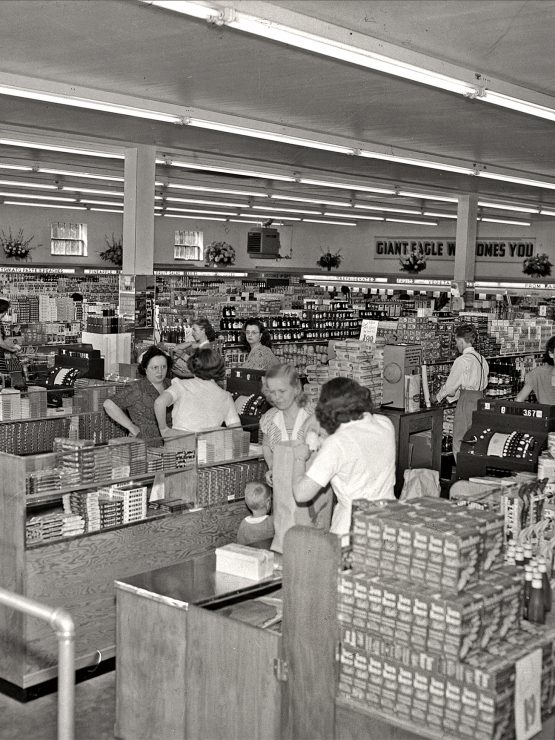
It’s hard to believe that a century ago, grocery shopping in Pittsburgh meant handing a list to a grocer who chose your products from shelves behind the counter. Self-service had been tried by Piggly Wiggly markets in 1916, but despite its success in the South and Midwest, the concept was not embraced by other groceries.
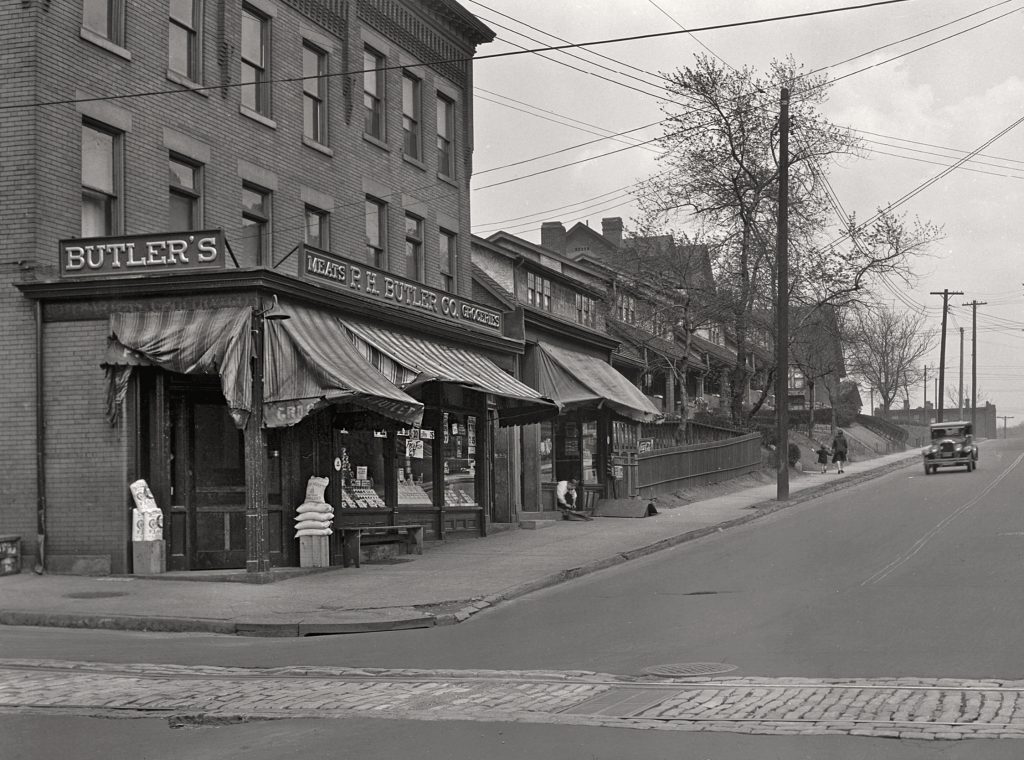
Oakland had a P.H. Butler grocery with its distinctive red sign. This view is looking east on Wilmot Street (now Boulevard of the Allies) at Ward Street, April 30, 1930, now the site of One Stop convenience store. University of Pittsburgh, City Photographer Collection.
One of Pittsburgh’s traditional grocers was the P.H. Butler company, established in 1898.1 It grew to only a few locations until 1922, when it was purchased by the United States Stores Corporation. New Butler groceries opened until its warehouse in the Strip District grew to serve hundreds of regional stores. Nonetheless, Butler began losing market share to larger chains like Kroger, Clover Farms, and especially A&P, which had 16,000 locations nationwide by 1930.2
Louis B. Smith, merchandising and advertising manager for Butler stores, lived in Penfield Court, a tiny street of townhomes tucked away off Penn Avenue in Point Breeze. Every day he passed a furniture store a block away that had closed and was for sale — the building remains across the street from Clayton, former home of Henry Clay Frick.3 Smith envisioned it as the place to try the self-serve, “supermarket” concept, but like other grocers, the Butler bosses were not keen on such a radical change.
Rebuffed, Smith left the Butler company to join Jefferson Wholesale Grocery Company of Punxsutawney, a wholesaler that welcomed his ideas.4 In July 1935, Smith’s new employer opened its first Jefferson Streamline Market at the location a block from his home.5 Other Streamlines followed that year on busy Pittsburgh roadways: West Liberty Avenue, Ohio River Boulevard, Saw Mill Run Boulevard, Forward Avenue near Murray, and East Ohio Street. In two years, Smith’s idea had “swept the tri-state market [and] brought forth 14 giant Streamline Markets under his management.”6
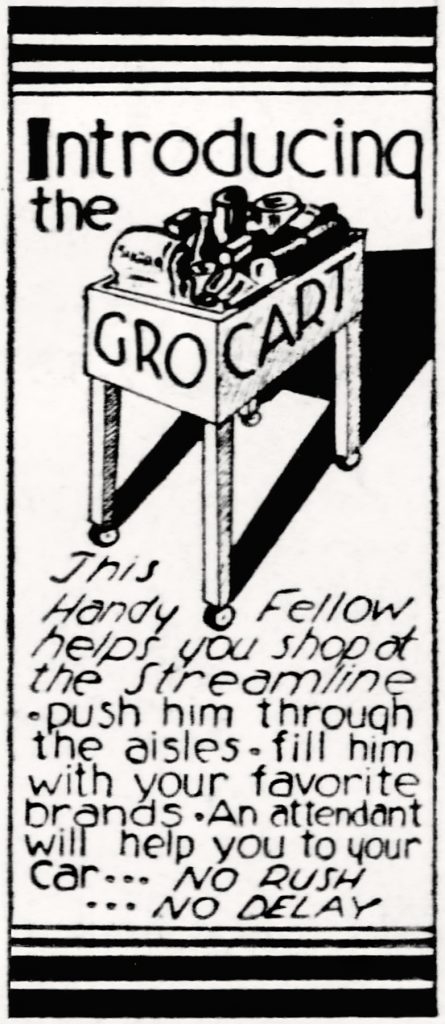
Ad for a Streamline Gro-Cart, 1935. Pittsburgh Press, July 26, 1935, 24.
Streamline Markets embraced “help-yourself” service by organizing aisles and installing shelves designed to eliminate bending. Meat and produce, normally sold at butchers and greengrocers, were included. Big signs indicated departments, including a bakery and delicatessen. Almost all stock was on display instead of paying for space to store inventory. Parking was free, and stores stayed open late. A thousand dollars’ worth of goods could be sold in a week with just a single employee, allowing prices to drop too: a bottle of Heinz ketchup that A&P sold for 23¢ was just 18¢ at Streamline.7
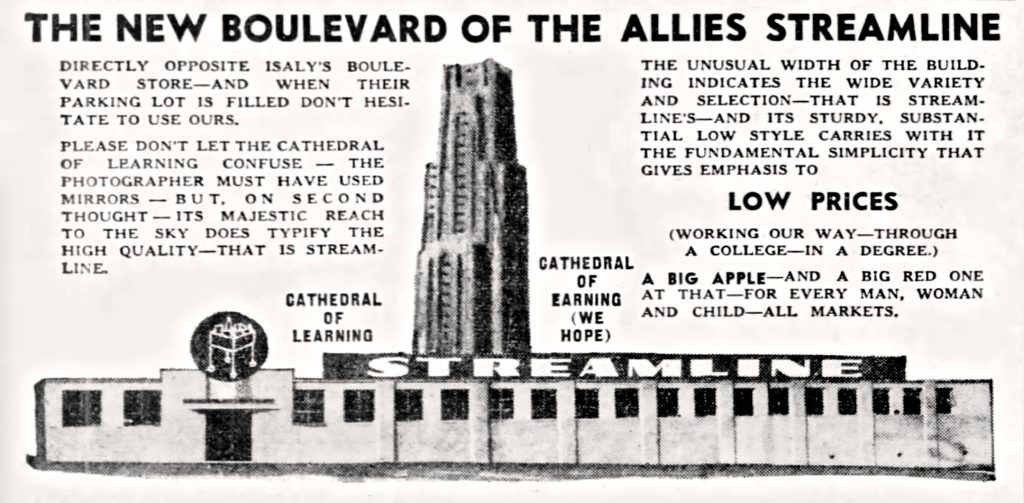
Ad for Boulevard of the Allies Streamline, across from Isaly’s dairy plant and salesroom, with the Cathedral of Learning looming behind. Pittsburgh Press, Oct. 29, 1937.
Streamline also introduced Western Pennsylvania to wheeled “Gro-Carts” to hold one’s purchases and speed up shopping. Grocery carts (or as locals would call them, buggies) were so new that they met resistance: “while the men protested that they were strong enough to carry baskets themselves, the women argued that they had pushed around enough baby carriages in their lives not to want the same yoke in the grocery store. Only the elderly customers used them.”8 Soon carts were refined to hold two baskets or added a child seat so that “housewives, loath to … drag the children along,” could sit them in the cart, thereby turning a “trying ordeal” into a “pleasurable jaunt.”9
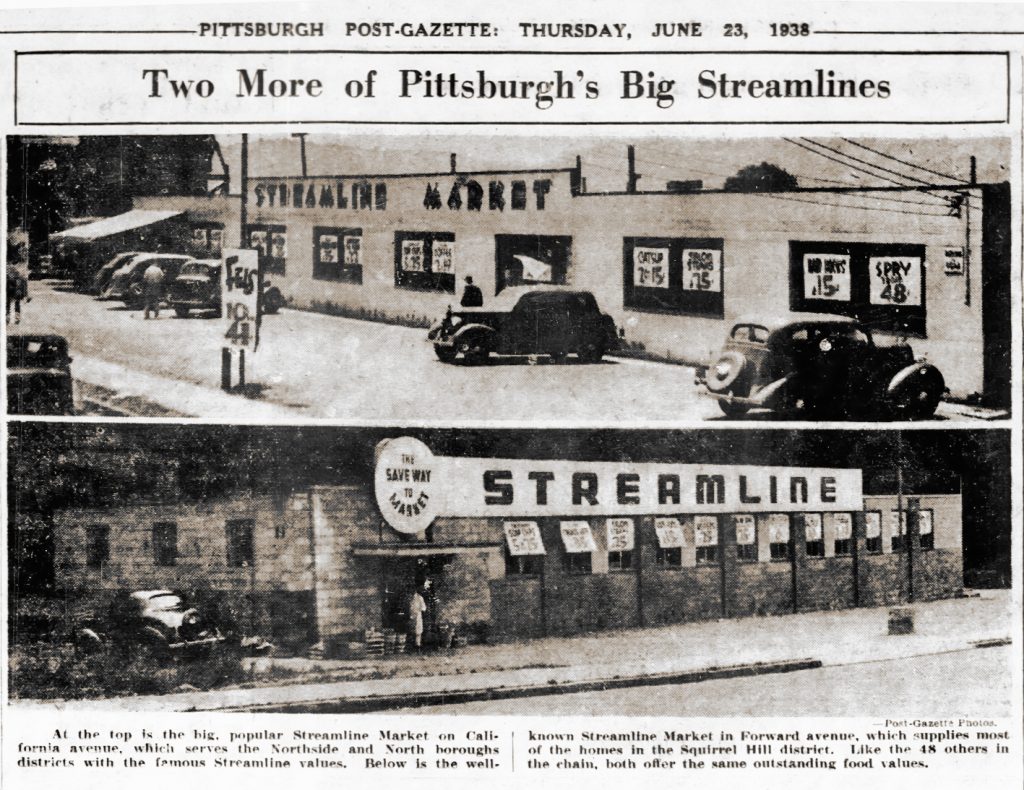
A newspaper pull-out section in 1938 featured stories and photos of Streamline stores, including California Avenue on the North Side, and Forward Avenue in Squirrel Hill. Pittsburgh Post-Gazette, June 23, 1938.
Pittsburgh’s upstart chain was not lost on other grocers. In June 1936, the first Giant Eagle supermarket opened on Brownsville Road in Mount Oliver.10 That same month, Kroger opened its first supermarket, in Braddock.11 A&P took another year to catch on, finally touting that its new store in East Liberty allowed customers to serve themselves in addition to standard counter service.12 By the end of 1937, A&P had closed 200 stores in Pittsburgh and replaced them with five supermarkets.13 In a reversal of long-time logic, having lots of stores had become a liability.
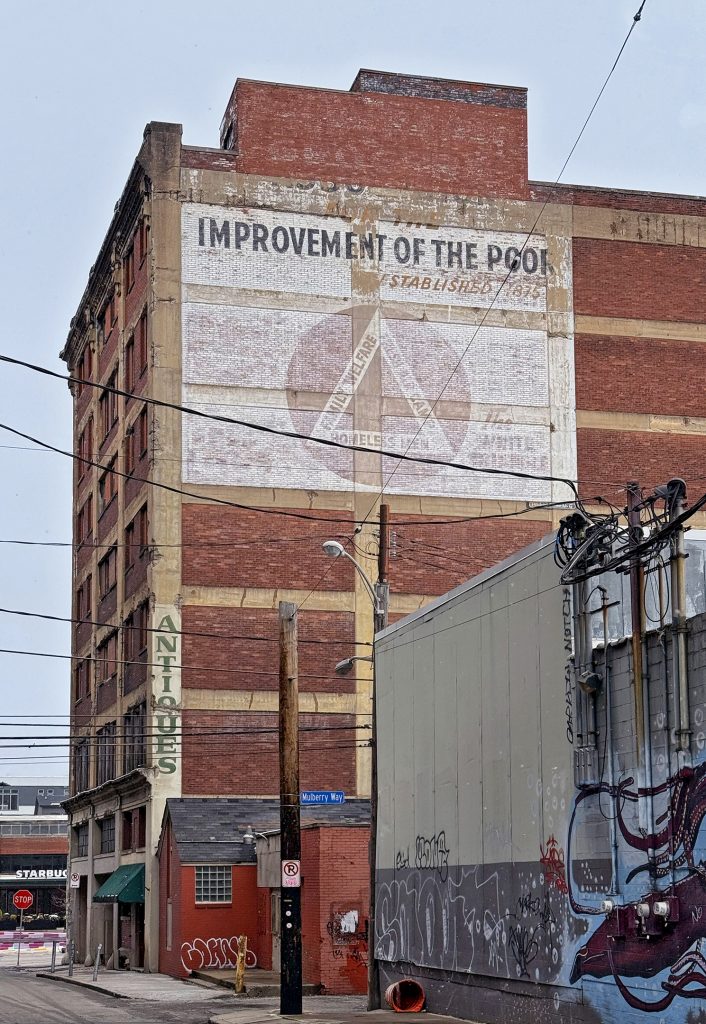
The Butler/Streamline warehouse in the Strip District is still there, red brick with white concrete dividers, across from the new Terminal Market on Smallman Street and home until recently to Mahla Antiques. On the side facing Penn Avenue, a popular but fading “Improvement of the Poor” painted wall sign covers a “GO STREAMLINE” sign; a portion of an earlier letter or two is starting to peek through the peeling sign atop it. Photo by Brian Butko, 2026.
Butler’s traditional groceries had been hemorrhaging money too, so in December 1937, Butler lured back Louis Smith as president. By June 1938, “Smith had Butler-Streamline operations consolidated into 48 supers, 12 of them in Pittsburgh.”14 Giant Eagle was now up to 10 supermarkets, and A&P was opening its 13th.15
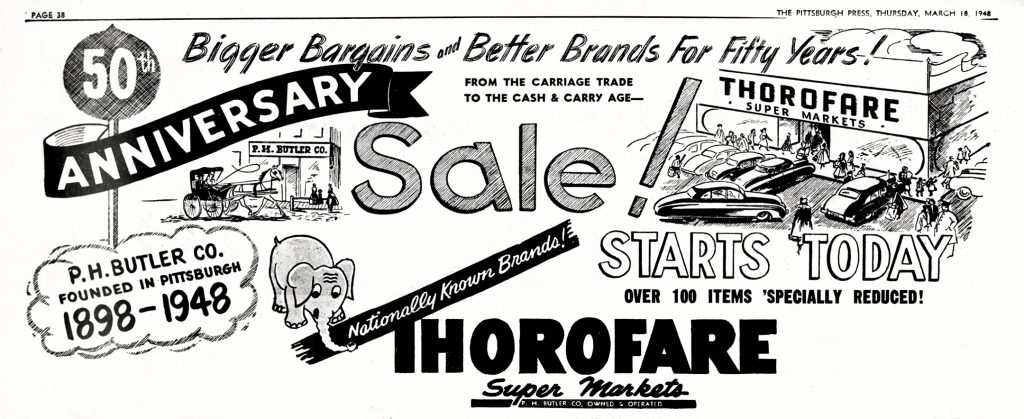
Fiftieth anniversary ad showing the evolution from Butler to Thorofare. Pittsburgh Press, March 18, 1948, 38.
Butler started opening new stores too, calling them Thorofare Markets.16 The name was borrowed from a realty company in Cleveland renting space for a Streamline Market.17 By January 1939, Thorofare was opening its 7th store, in Squirrel Hill, said to be experimental for being not only self-serve but also “in the middle of a thriving business district rather than in a rural or residential district.”18 Thorofare had become the more modern of the two intertwined brands.
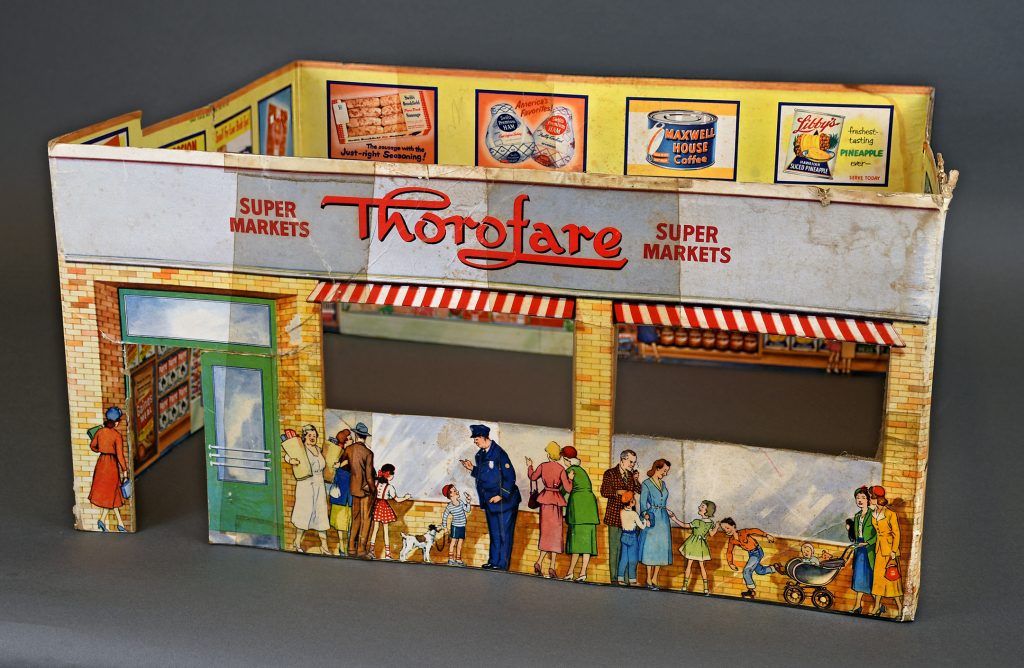
A cardboard Thorofare supermarket playset, c. 1950. Photo by Liz Simpson Romano.
A few months later, what was proclaimed to be the region’s first shopping center with parking opened as the “Mt. Lebanon Driv-In Mart” [no “e”], which included both a Streamline and a “Thorofare Superette.”19
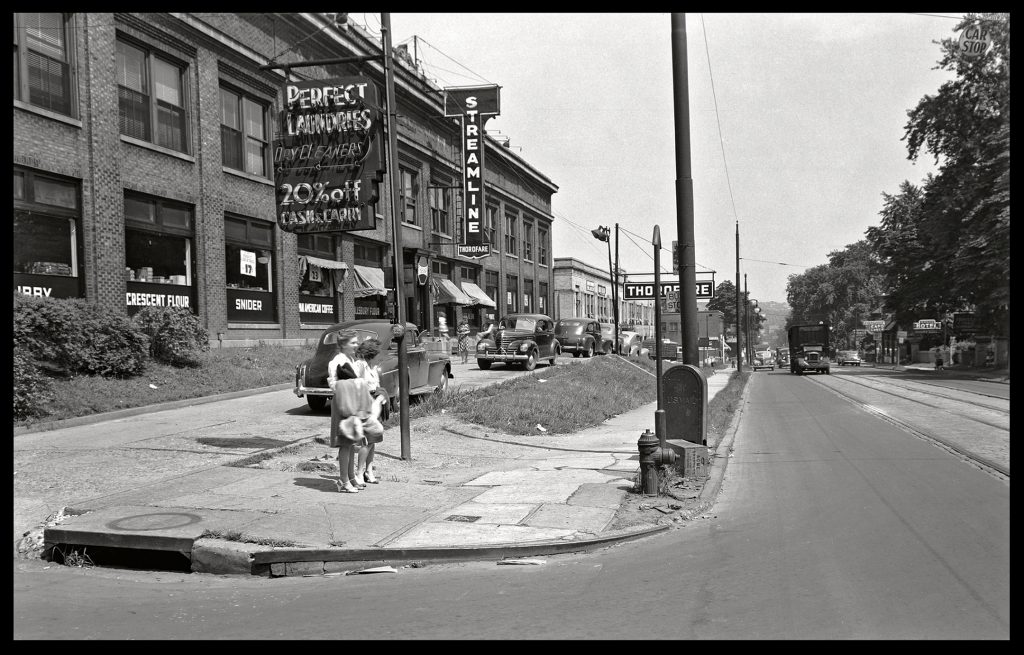
Looking east on Penn Avenue to Pittsburgh’s first supermarket, opened 1935, here in 1942 after it transitioned to a Streamline Thorofare. Built c. 1919 as offices for Westinghouse Electric & Manufacturing Co., the building remains as does the still-open Evergreen Café peeking out across the street.
Maintaining two overlapping chains was enough of a challenge that in 1943, Thorofare took over 18 Streamlines in the Pittsburgh area.20 By July, an ad proclaimed 48 merged Thorofare-Streamline Markets in the area, but the word “Thorofare” was much larger on the company’s new octagonal logo. The remaining Streamlines were rebranded as Victory Markets, then later Sparkle, and then Loblaw.
Thorofare prospered in the 1950s and ’60s, growing to perhaps 100 stores, but it would experience its own bumpy history. The last of its supermarkets closed in 1982, bringing an end to not only that popular chain but its Butler and Streamline forebears too.21
For the full story with more images, check out the Summer 2026 Western Pennsylvania History magazine, available from the Heinz History Center’s Museum Shop.
About the Author
Brian Butko is the author of more than a dozen books on Kennywood, Isaly’s, the Lincoln Highway, and most recently Bettis: Where Pittsburgh Aviation Took Off with Sue Morris. He is Director of Publications at the Heinz History Center.