
In 1933, Allegheny County’s three commissioners were choosing equipment for the restaurant at the county’s new airport in what is now West Mifflin. They bought a griddle, but not a griddle stand. (“Let somebody hold it,” suggested one grumpy commissioner). Whether to buy a sink also caused a firestorm, but luckily two of the three men voted in favor of clean dishes. Another commissioner refused to pay for chairs and tables; they compromised, as one newspaper said, “to make the place as uncomfortable as possible with three steel ones.” Most famously, they voted down an electric toaster for being “too snooty” and “la-de-da” for making multiple slices — despite it being half the cost of similar industrial models.1
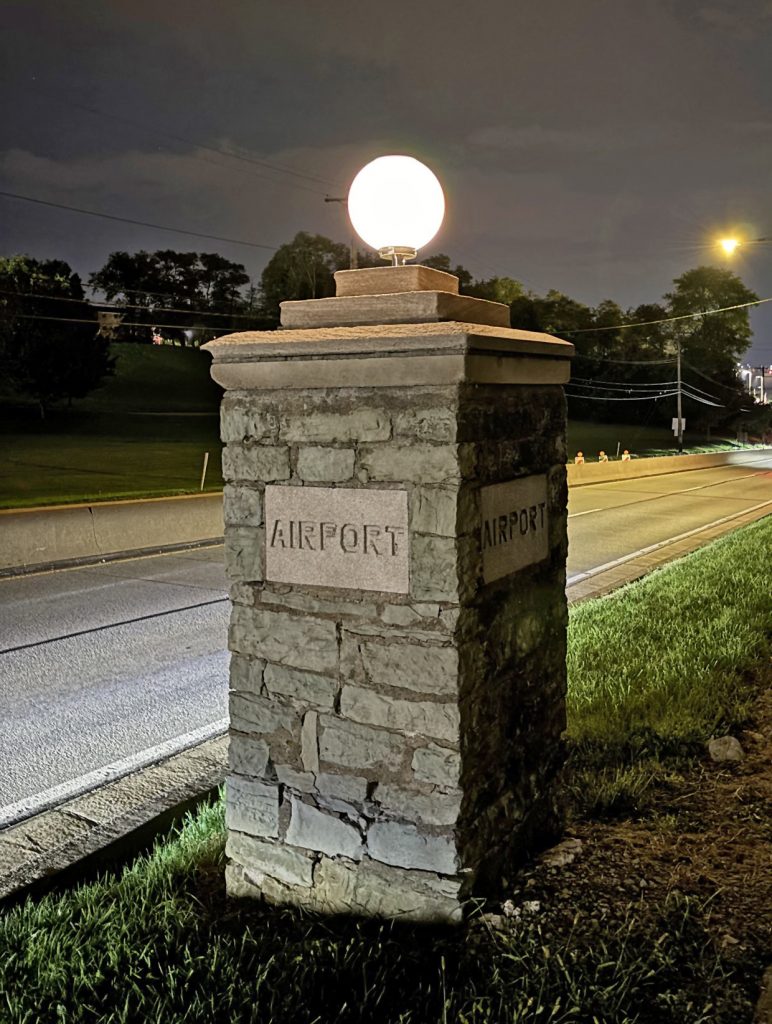
A new globe sits atop a pillar at Allegheny County Airport (AGC). Photo by Bryan Dietz.
Which brings us to the pillars. While the commissioners were rejecting a sink, tables, and toaster for the beanery (yes, that’s what this restaurant and similar ones were often called a century ago), they approved the building of stone pillars to mark the airport’s entrances along Lebanon Church Road. These were sturdy square sentinels, about 6 feet tall, the word “AIRPORT” cast in a concrete rectangular plaque and topped with white glass globes for a touch of elegance … and likely to help drivers avoid hitting them at night. Two were built to guard the main airport entry at Camp Hollow Road, and another two were set at a secondary entrance a quarter mile to the west.
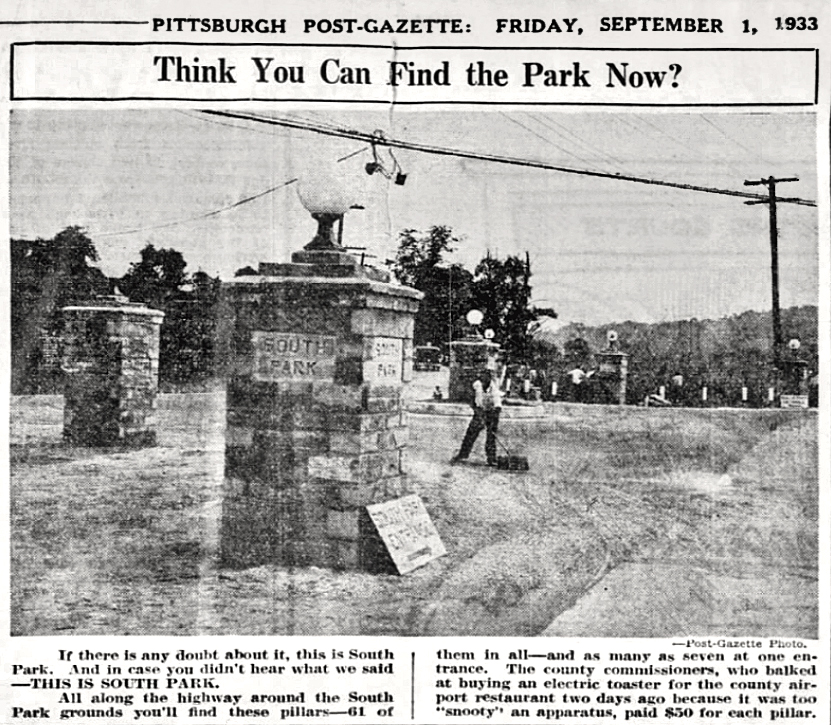
This 1933 article mocked the number of pillars at the entrance to the county’s South Park. Pittsburgh Post Gazette, Sept. 9, 1933.
The stone pillars were part of a wider project in 1933. Though the airport got a few, the majority were installed at the county’s South Park — a jaw-dropping 61 pillars. The park entrance alone had seven pillars (with “SOUTH PARK” in the concrete plaques) in case visitors missed the first six. Not surprisingly, that many pillars brought calls of frivolous spending too.
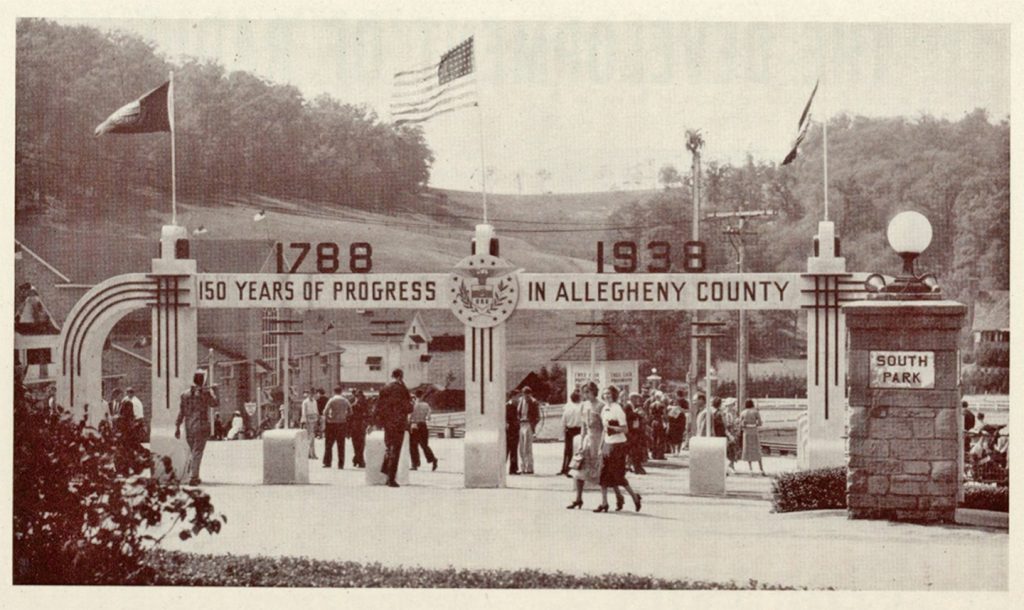
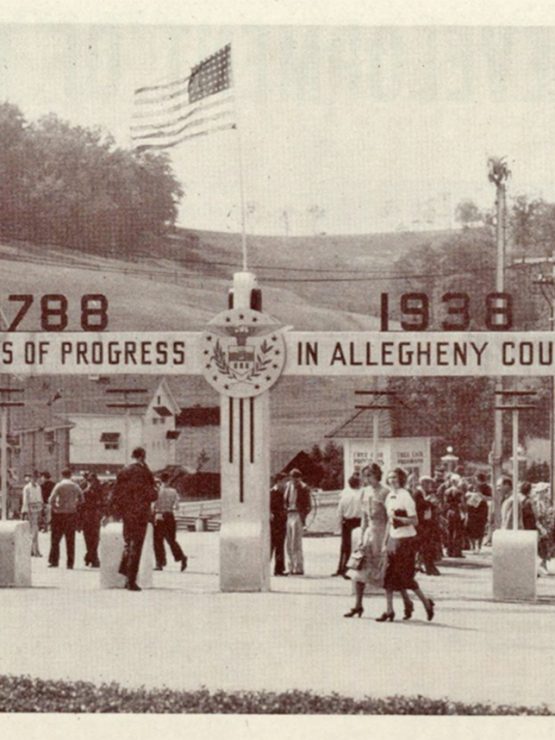
Entrance to the Allegheny County Fairgrounds in the 1938 Souvenir Program. HHC Detre L&A, CASE S555 P37 A46 d.
The commissioners claimed that stone for the pillars had come at no cost from the Parkview Poor Farm, but others pointed out that county laborers had to build each one, estimating the labor expense at $50 each, about $1,300 in today’s money. In addition, someone undoubtedly had to be paid to design them, and then there was the cost of purchasing globes, etching the county shield on each one, casting the concrete plaques, and wiring them in remote areas. Of course, there was a cost to buy bulbs and keep them lit too.
South Park’s pillars are mentioned in the 1934 annual report of park progress:
Attractive solid stone pylons were erected at each road entrance to South Park. Each pylon was wired for light and a large white globe set on top decorated with the County Seal. These pylons have added dignity to the various entrances of the Park and their utility is, of course, without question. Many new large and substantial direction signs were built and erected and entrances landscaped in an attractive manner.2
Newspapers didn’t comment much on the pillars, though in 1934, the dedication of nine memorials to honor Pittsburghers who fought in the World War was a highlight of the Allegheny County Fair, and some of those memorials were on stone pillars.3
As 15,000 looked on, officials dedicated a living memorial of blooming sage to the Twenty-Eighth Division, and the Joyce Kilmer Memorial in the center of a prominent traffic circle in Corrigan Drive. Designed by famed architect Henry Hornbostel, the latter was dedicated to Kilmer, killed in action but best known for his poem “Trees” that opens with, “I think that I shall never see, A poem lovely as a tree.” Surrounding this circle are a number of the stone pillars, with plaques commemorating (capitals retained from the plaques) Allegheny Arsenal Explosion, First Shot of the Whiskey Insurrection, Honorable William Flinn, Alexander Negley, Edward Vose Babcock Washington Infantry, Private First Class Edmund M. Wilson, and The Ladies of the Grand Army of the Republic. Most have unique plaques on each side.
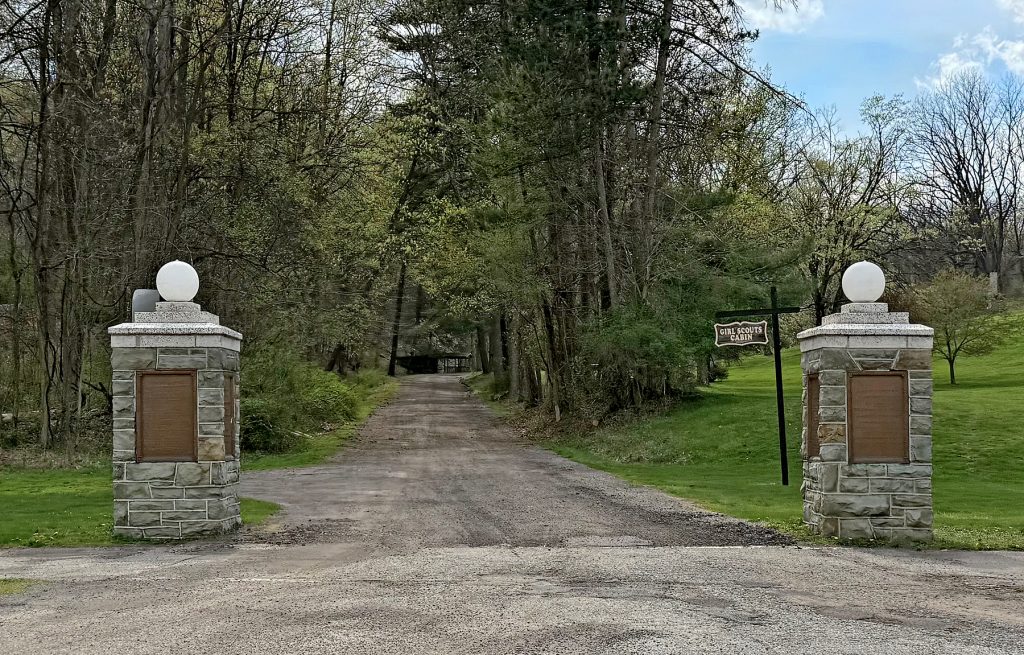
Two of the pillars at the traffic circle on Corrigan Drive guard the entrance to the Girl Scouts Cabin. One of the sides is dedicated to Private Edmund M. Wilson, the first marine from Allegheny County to be killed in World War I, June 3, 1918. Photo by Brian Butko, 2025.
Dozens of stone pillars still dot South Park: some of the originals and many others of those dedicated to a military unit, veteran heroes, and other local notables. A few, especially the originals noting park entrances, are looking a bit worn, and unfortunately, some have disappeared or lost details in recent years. The globe atop one at McCorkle Road across from South Park Amphitheater disappeared around 2017, and the globe (or concrete replacement) went missing in 2023 at the major intersection of Corrigan Drive and Baptist Road. A mile west of Corrigan Drive on Library Road in Bethel Park, two pillars that marked the entrance to a county maintenance warehouse disappeared over time between 2005 and 2020, though for years, one of the plaques (“District No. 5” in concrete) was kept on the ground at the entrance.
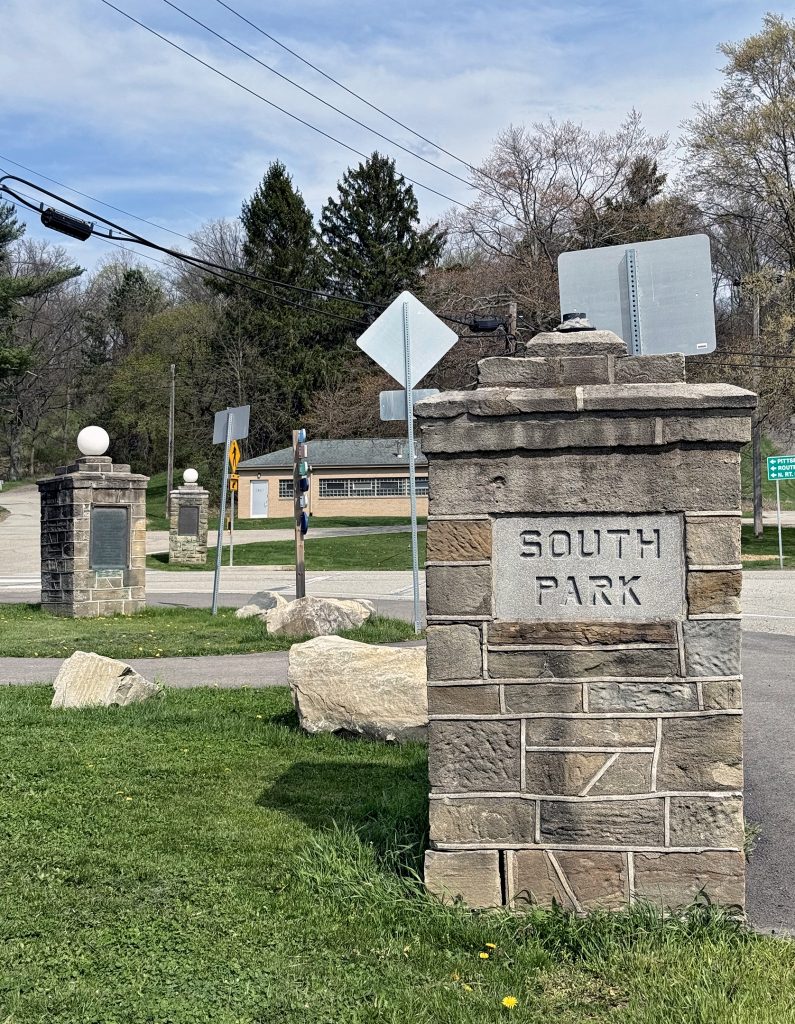
Three of the remaining pillars at Corrigan Drive and Brownsville Road, adjacent to the children’s playground. Photo by Brian Butko, 2025.
On Corrigan Drive across from the Buffalo Inn, a parking lot remodeling in 2020 took out two pillars that featured both concrete and iron plaques plus their globes. A block west, the same project took out two originals at the intersection of Brownsville Road, where the seven controversial pillars (and more nearby) had remained intact with globes and concrete plaques. Were the pillars saved? Their globes and plaques too? A contact at the county did not know. Overall, the park’s pillars seem well-maintained, but three of the remaining pillars at this intersection have since lost their globes too.
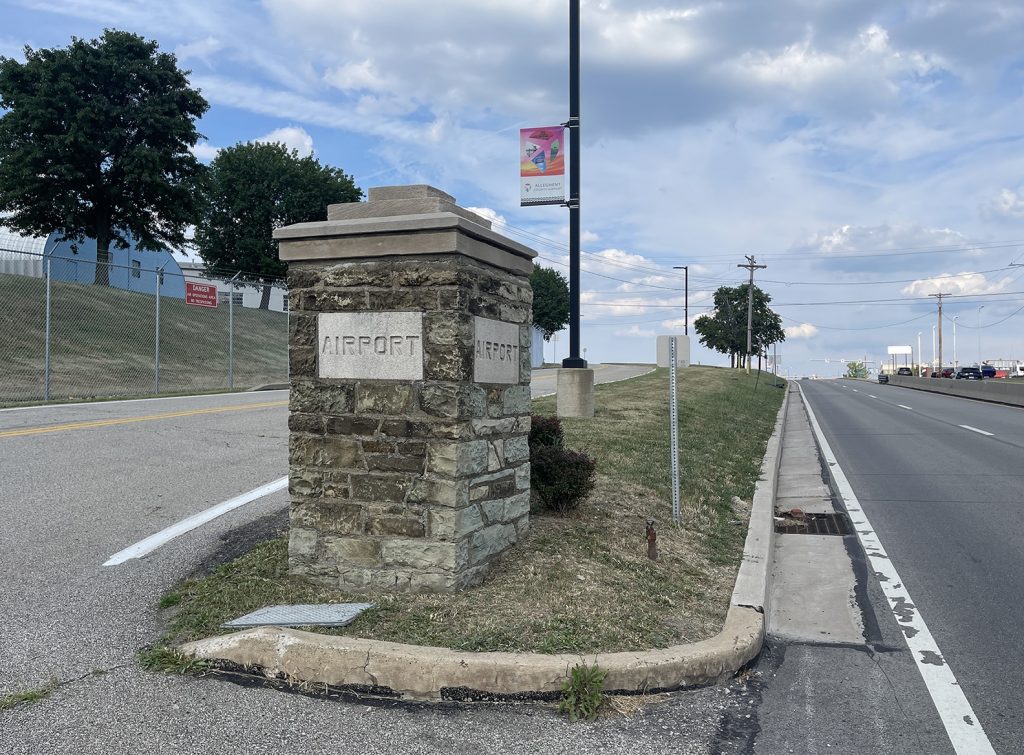
One of the surviving pillars at the county airport. Both received new globes in September 2026. Photo by Brian Butko, 2024.
Carolyn Savikas, Friends of South Park chairperson, said her volunteer group does what it can to help beautify the park, such as purchase and place flags in the traffic circle and look after the pillars. She believes the removed pillars are at the Public Works maintenance lot near the county’s wave pool. Others report seeing remnants left behind the Buffalo Inn. Most impressively, the Friends of South Park raised funds to purchase 20 new solar globes to replace missing ones in the park, though they are waiting for the county to mount the globes.4
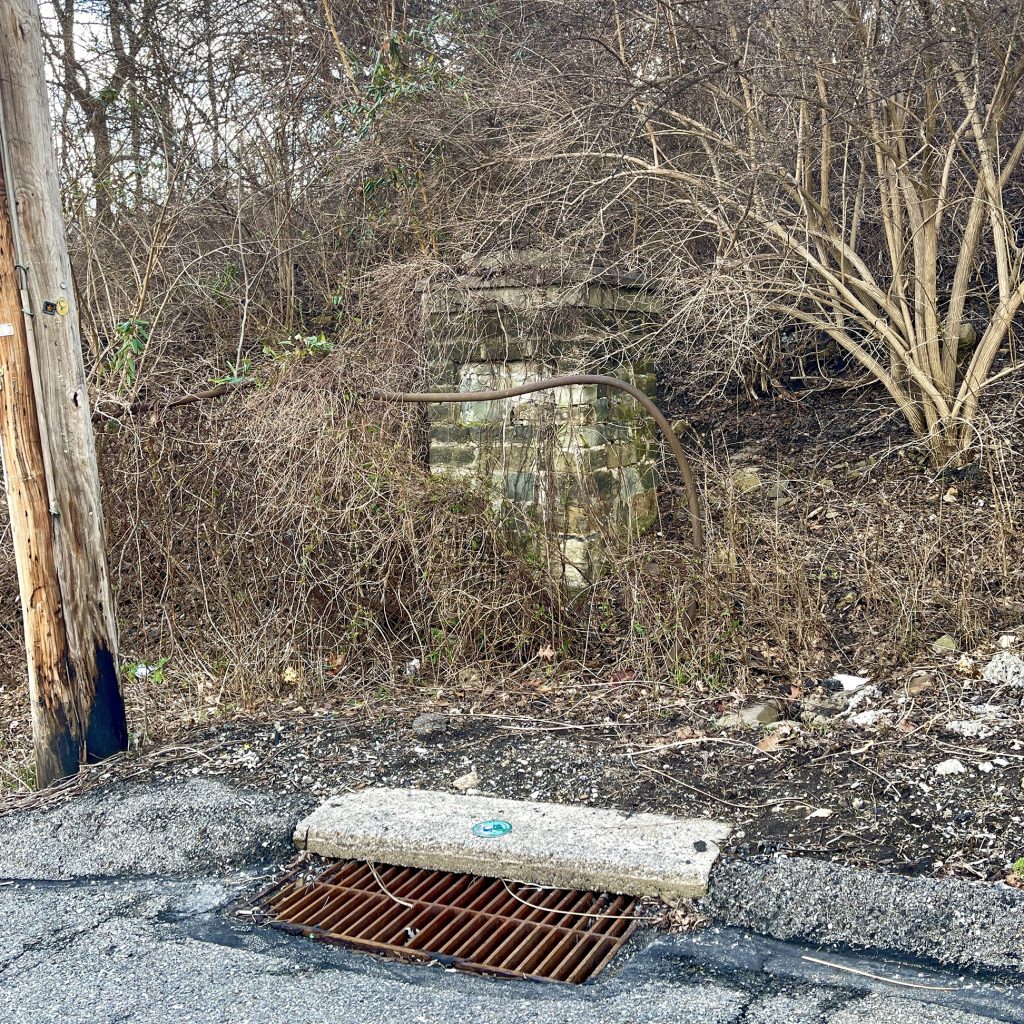
The abandoned Flyers Club pillar across from the airport on Curry Hollow Road. Photo by Brian Butko, 2024.
The two pillars at the county airport’s main entry are long gone, but the second pair have been taken care of and remain in amazingly good shape nearly a century later. Interestingly, another pillar sits nearby, abandoned in a tangle of underbrush on Curry Hollow Road, 300 feet south of Lebanon Church Road. The concrete plaques were removed long ago, but they would have marked the entrance to the Flyers Club, a farmhouse-turned-lounge and lodging for pilots that opened in 1935. Like the airport and its restaurant, the club’s expenses were a constant flashpoint until it was demolished in 1955; it was replaced in 1966 by a Holiday Inn, which in remodeled form is still there.
Carolyn Savikas’s work in acquiring globes for South Park inspired me to ask the Allegheny County Airport Authority if they might add new solar globes to the county airport pillars too. Bryan Dietz, Senior Vice President of ACAA, took on the task, and I’m happy to report that two globes once again sit atop the pillars at the lower entrance to Allegheny County Airport. They are a welcome sight, especially at night, and congratulations to the airport authority for its attention to aesthetics.
About the Author
Brian Butko is Director of Publications at the Heinz History Center and co-author of “Bettis: Where Pittsburgh Aviation Took Off,” available from the History Center Museum Shop.
Look for more about the building of Allegheny County Airport and the launch of airmail at nearby Bettis Field in the Spring 2027 issue of Western Pennsylvania History magazine, which History Center members receive free.
Find a list of historical markers and memorials in South Park here.