
First came surveyors, hammering pegs into Charles Lutz’s land. He asked them why, but their lips were sealed. Then came real estate agents hounding him to make a deal.
Lutz couldn’t piece things together until news broke that a new airport was being planned — and his farm was in the way. He turned down the county’s offers to buy his land, but workers appeared anyway, chopping down his orchards and blasting pasture where livestock and chickens grazed. Still, Lutz refused to leave. He believed the law protected his right to remain in his colonial-era log house, tending and farming the land he called home: “I won’t leave until they deal fairly with me…. I’m going to stay right here until I get my rights.”1
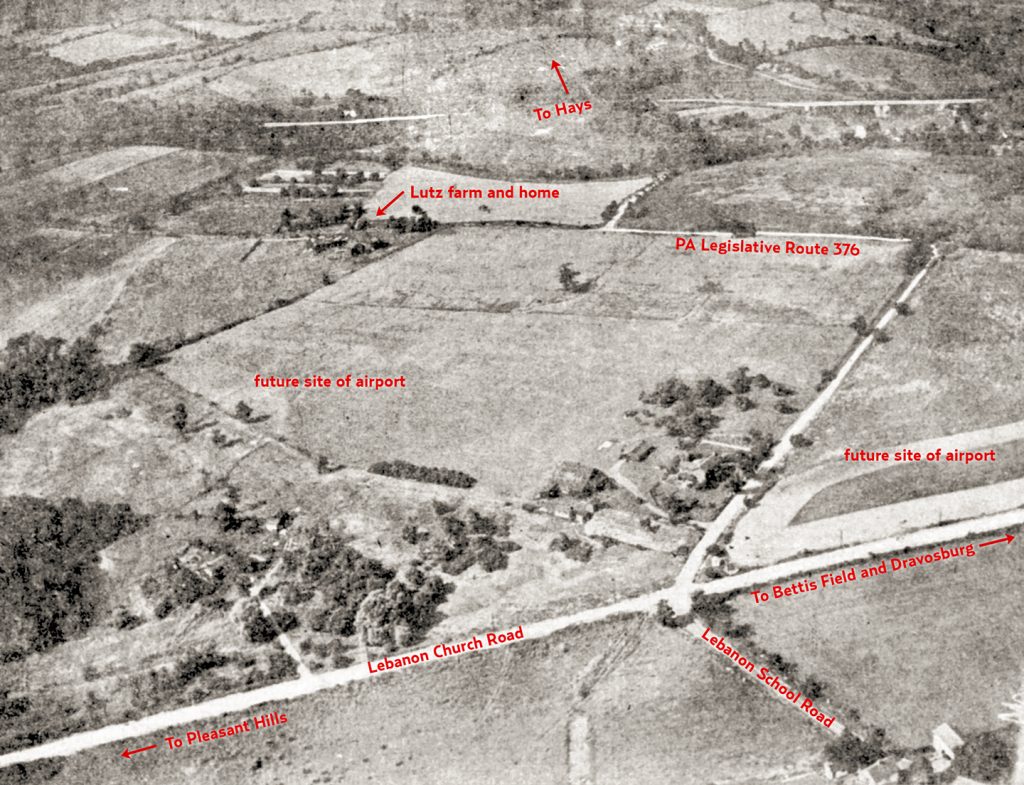
The future site of Allegheny County Airport. The Lutz property sat right where the main runway was planned. The triangle of land at bottom is now part of Lebanon Church Cemetery, the final resting place of Nathaniel Patterson, who built the log cabin that formed the basis of the Lutz home. Pittsburgh Post-Gazette, Aug. 15, 1928.
In October 1927, Pittsburgh’s Chamber of Commerce recommended a survey of possible sites for a new airport. Existing airfields like Rodgers in O’Hara, Mayer in Bridgeville, and nearby Bettis Field in Mifflin Township (now West Mifflin) were unsuitable; as one article proclaimed, “To hold its own in aviation, Pittsburgh needs an adequate, municipally owned field that can be reached quickly from the heart of the city.”2
By August 1928, the rolling hills astride Lebanon Church Road, just a mile west of Bettis, were declared “the best available airport site within 10 miles of downtown Pittsburgh.”3 Of course, many suddenly argued there were better sites, particularly those who saw the potential to sell their own land for a big profit.4 County voters already had approved $1.5 million in bonds to finance the endeavor, and the city agreed to contribute a half-million dollars too.5
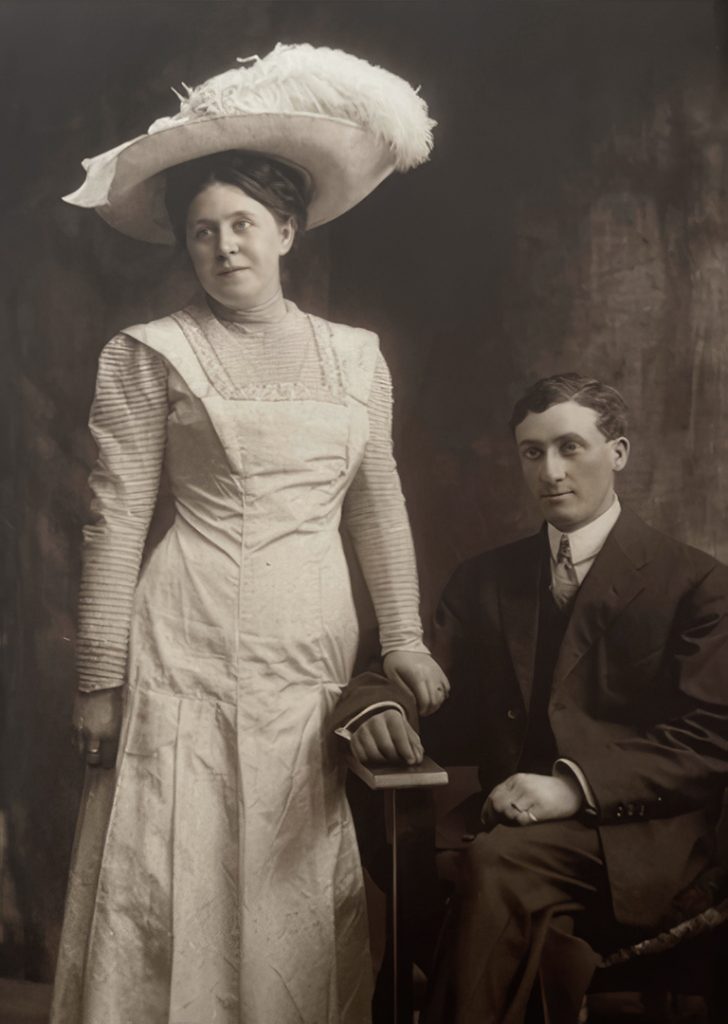
Mary O’Neil and Charles Lutz, likely when they married in 1909. Courtesy of Lois Lutz, Ancestry.com.
Ground was broken in July 1929 even while dispossessed property owners contested lowball offers. Their land was taken by the county through condemnation proceedings, a mechanism allowing authorities to offer below-market value compensation. The $2 million was quickly spent to level the challenging terrain, leaving little to pay for property, let alone construct a terminal building. Landowners resentfully accepted the offers, allowing the county to gobble up some 330 acres of farmland.
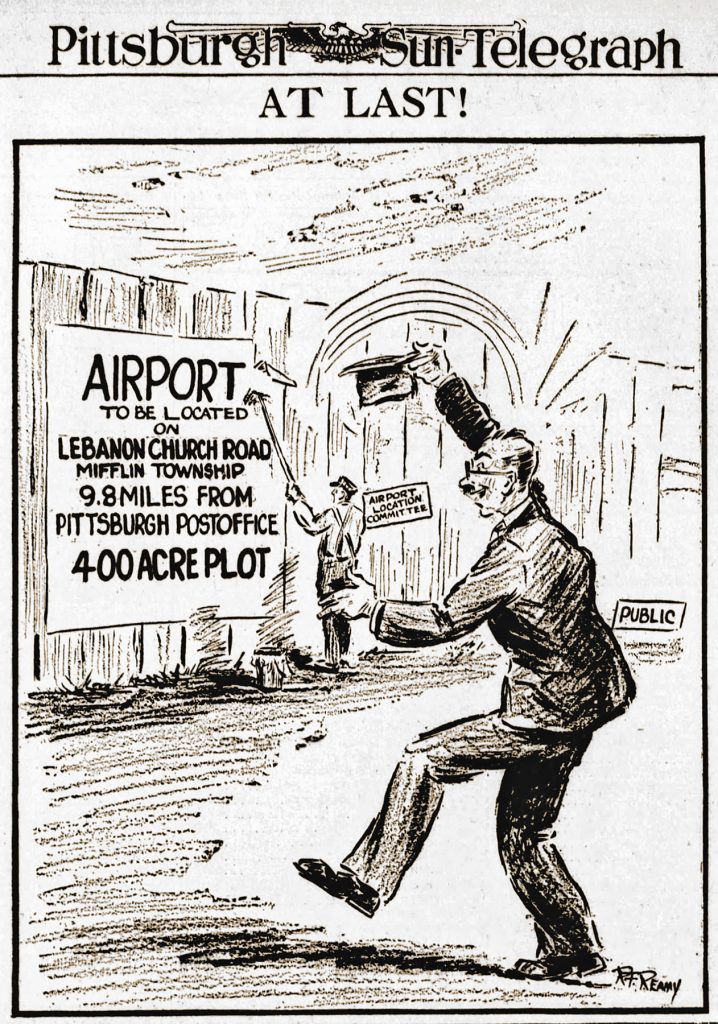
1928 cartoon portraying the airport location news being celebrated by the public. Pittsburgh Sun-Telegraph, Aug. 15, 1928.
All except Charles Leo Lutz; even after the appeals, the 45-year-old farmer held out. His 17-room home of logs and bricks, started by early settler Nathaniel Patterson in 1758, sat on 78 acres of farmland.6 It included three fireplaces and loopholes 12 feet off the ground for frontier defense. In 1929, assessors valued the property at $24,625, which county commissioners appealed as too high. Lutz and his wife Mary filed their own appeal, valuing their property at $135,000.
Lutz had purchased the house and land in 1922 from the great-grandchildren of Patterson for just $9,665, but he felt that skyrocketing demand for airport land made it worth far more than the county’s valuation.7 A Common Pleas Court appeal verdict awarded them $40,000, but Charles Lutz still wasn’t satisfied and refused to budge.8 Local newspapers informed the public that while the case was undecided, homestead laws protected the Lutz house so long as he was living in it and refused to accept the awards.9
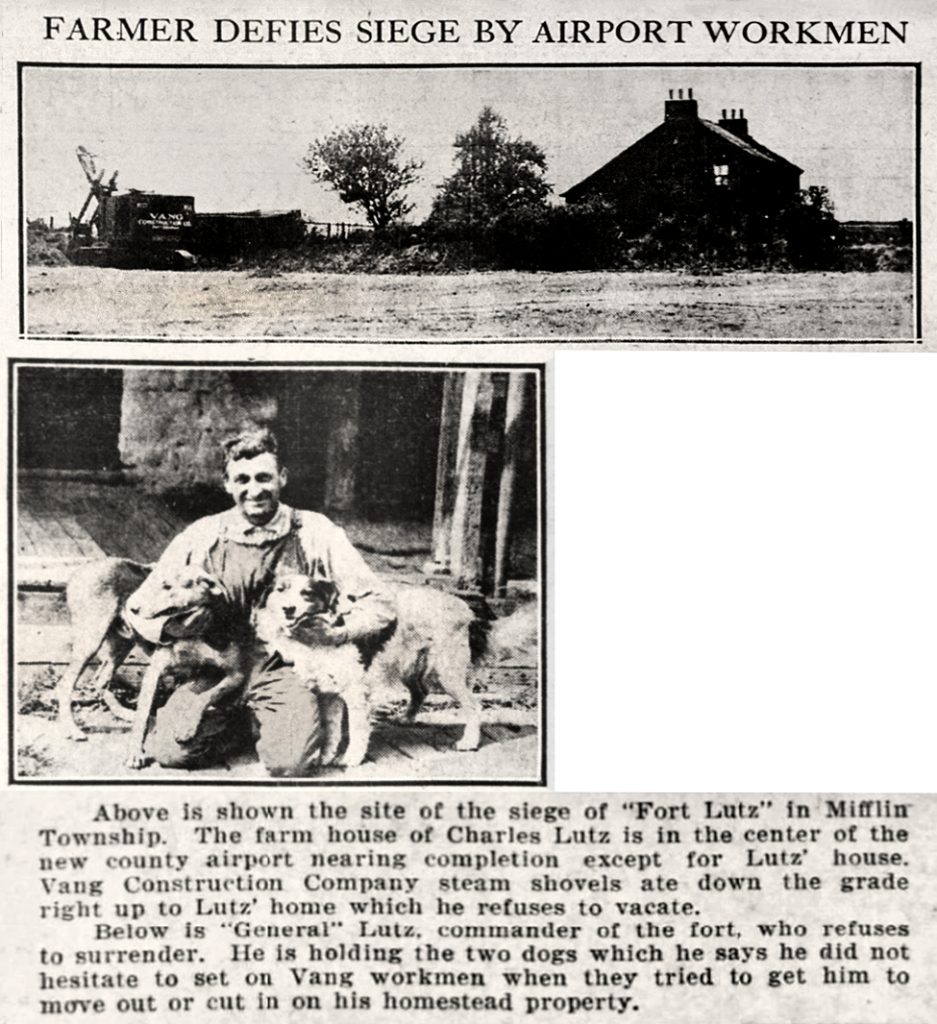
The home and farmland of Charles Lutz sat right where the county wanted to build an airport. Pittsburgh Press, July 25, 1930.
However, their acreage was not protected and, in fact, was in the middle of the proposed runways. While the Lutzes stayed put, Vang Construction Company worked around them. Lutz described the situation in July 1930:
They tried to make it so disagreeable for us that we’d give up like the others did and get out, but we just sat tight. They cut down my 2,300 peach trees with the crops on them unpicked. They hacked down my apple trees and graded up two acres of grapes. They even harvested and baled my hay crop and hauled it away without paying me a cent…. They put a railroad spur as close as they could in my front yard and backed their steam shovels under our windows.… Workmen touched off explosives as close as they could and almost every window in our house was broken, but we boarded them up and stayed…. We had to move our bee hives and there was no pasture left for my livestock or chickens.
Mary Lutz couldn’t keep anything clean from all the dust, and 16-year-old daughter Madeline was mocked by workmen when she got stuck in mud while walking the half mile to reach the main road. The county implored him to settle, citing the delays and difficulties he was causing. Still, the family remained.
In August 1930, the Lutzes were served with an injunction to vacate their property within 60 days. They appealed to the Pennsylvania Supreme Court but lost again. Finally, six deputy sheriffs armed with shotguns, rifles, and revolvers showed up to evict them on Dec. 8, 1930. Lutz, hunting rifle in hand, debated from his front porch until relenting. Tractors towed in four trucks across the quagmire to cart away their belongings to a McKeesport warehouse.10
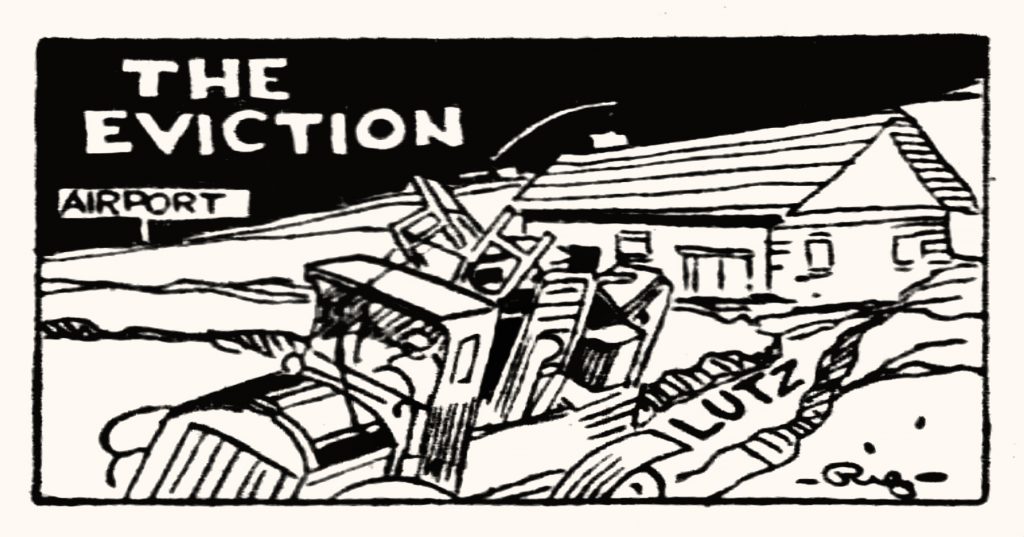
The Lutz farmhouse eviction saga led to this cartoon portraying the situation. Pittsburgh Press, Dec. 13, 1930.
Lutz bought a small house in Hays. A year later, he was willing to settle out of court for $75,000, but the case dragged on for seven years, including a second appeal to the Pennsylvania Supreme Court. It was finally settled in 1937 for $33,300 plus $3,000 interest. Amid the chaos, Charles and Mary had legally separated in 1932, and Mary sued for the award to be administered by a trust.11 The couple subsequently divorced.
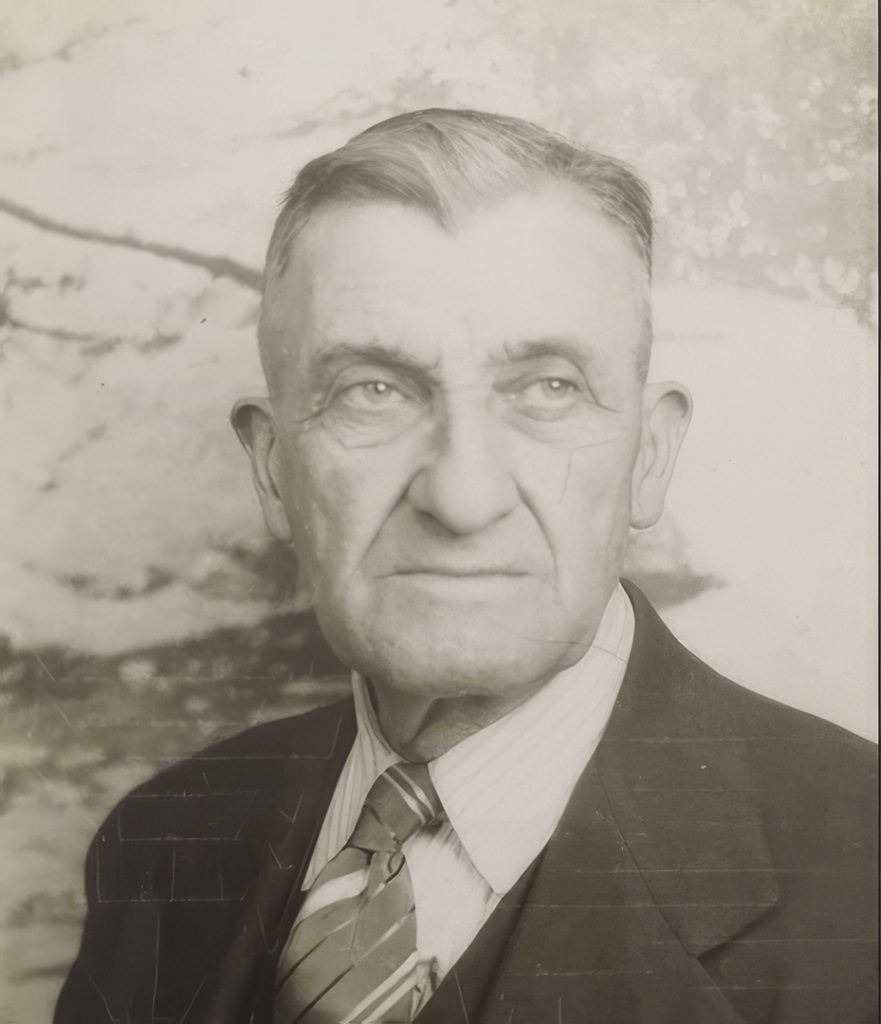
Charles Lutz later in life. Courtesy of Lois Lutz, Ancestry.com.
The historic logs of the Lutz home were salvaged by F. Lemoyne Page, a financier who had been instrumental in ushering in local commercial aviation. Page and friends disassembled the logs, intending to rebuild the cabin at his home in Fox Chapel.12
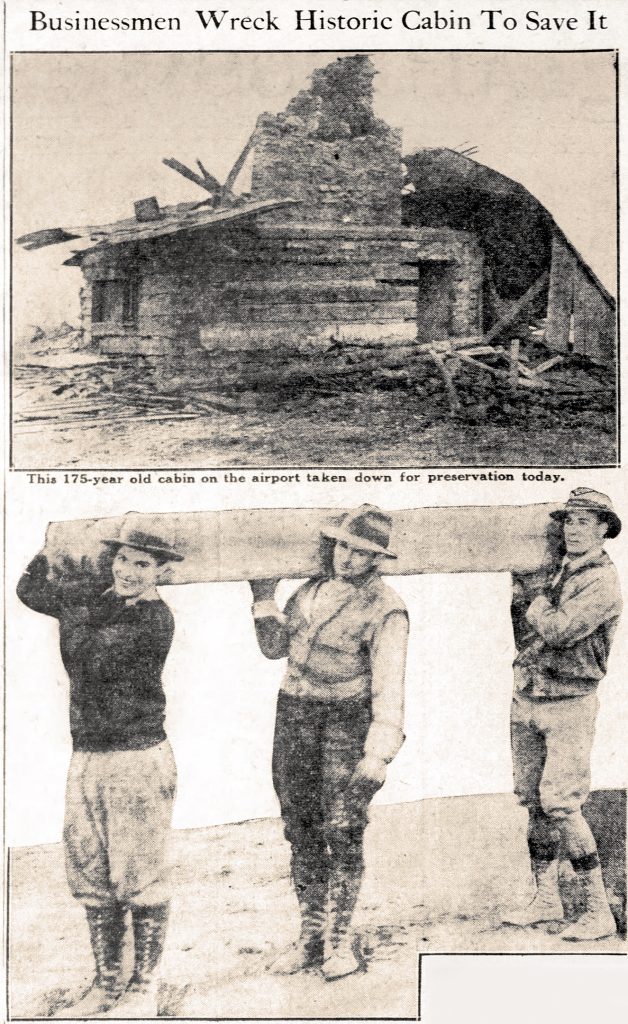
Fox Chapel financier Francis LeMoyne Page leads the dismantling of the Lutz home, intending to reassemble the original c. 1758 cabin on his own property. Pittsburgh Press, Jan. 12, 1931.
More funds were appropriated for the terminal, bringing the appropriation to $3.5 million,13 with endless charges and counter-charges hurled about waste, grift, and fraud. Nonetheless, Allegheny County Airport14 opened on September 11, 1931, to great acclaim. Its popularity led to a major expansion just five years later, and it remains a vital resource for regional aviation. The battles over farms and money were quickly forgotten, as was the colonial history of the land.15 Even the 172-year-old logs, carefully saved and hauled away, were seemingly never reassembled.16 The story of the home, and Lutz’s battle to save it, faded from memory, leaving only tales in old newspapers.
About the Authors
Brian Butko and Sue Morris are authors of “Bettis: Where Pittsburgh Aviation Took Off.” Read more about the Lutz family and the building of Allegheny County Airport in the Spring 2027 issue of Western Pennsylvania History magazine.