
An enterprising local woman provided airline passengers and workers with fine dining options beginning in the late 1920s. The first meals served aloft prepared in Pittsburgh came from Katherine Baker’s Pleasant Hills kitchen. She was known as “Ma Baker” — but she was no plump, flour-dusted grandmother.
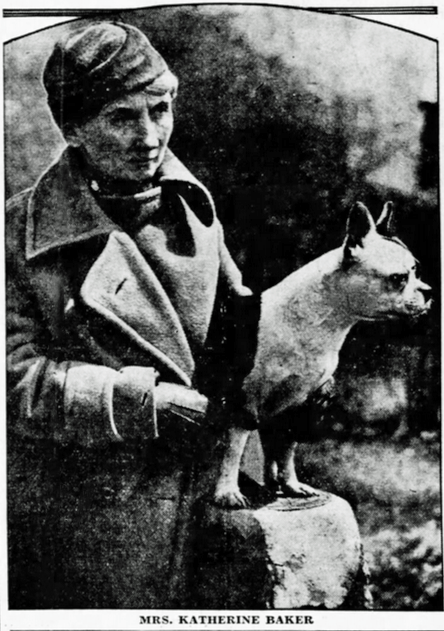
Kitty Baker poses with her dog. Pittsburgh Press. May 10, 1935.
Wilbur Wright carried the first airplane passenger 2,000 feet across a North Carolina beach in 1908, but paying passengers were still a novelty nearly two decades later. By 1928 Pittsburghers could purchase one of four seats in the enclosed cockpit of a high-wing Fairchild monoplane or join a dozen or so passengers in a noisy Ford Tri-Motor cabin. They could travel to Cleveland, Washington, D.C., or even New York, but would have counted themselves lucky to be offered a cup of coffee before taking off from Pittsburgh’s Bettis Field. There were no industry-wide initiatives to guide airline catering until a local woman with a colorful background took it upon herself to inaugurate dining in Pittsburgh’s skies.
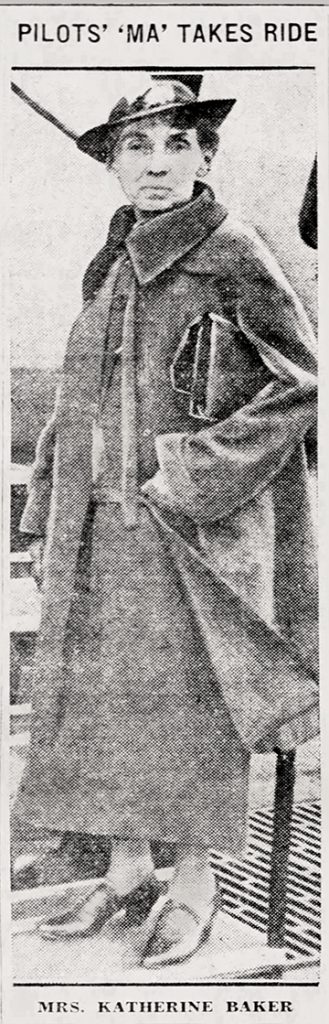
“Pilots’ Ma Takes Ride.” Pittsburgh Press. April 23, 1935. The caption on this photo of Kitty Baker reads, “Ma” Baker left her kitchen in Pleasant Hills Farm yesterday to fly with “one of her boys.” She is shown above about to board a TWA liner for Kansas City. The coziness of her farm house tavern or flavor of her cooking has made Mrs. Baker a second “mother “to the polits [SIC] flying in and out of Pittsburgh.
By 1920 Kitty was operating a tearoom in Greenwich Village, but within a few years was “pretty sick of that literary and theatrical crowd.” By 1926 she had followed her family to resettle in Pittsburgh’s southern suburbs and found work operating tearooms on Fifth Avenue in Shadyside and at the stylish Ruskin Apartment Hotel in Oakland (now the University of Pittsburgh Ruskin Hall residence).
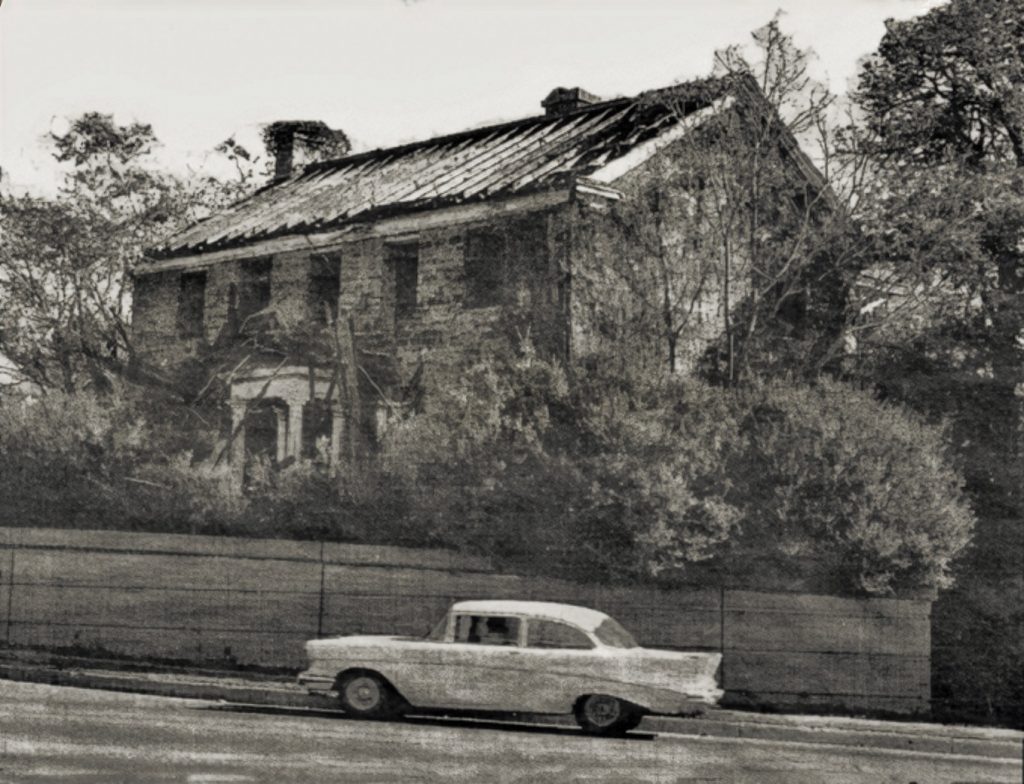
This photo of Katherine Baker’s former Pleasant Hills Inn was taken shortly before the circa-1799 building was demolished in 1959. A U-Haul company stands on the site today. Courtesy of West Jefferson Hills Historical Society.
Kitty opened her own tearoom in 1935 at the Pleasant Hills Inn, a former stagecoach tavern situated at the prominent intersection of Saw Mill Run Boulevard and Clairton Road. Dusty liquor licenses and bills dating to 1830 that Kitty found in an attic trunk prompted a Press newspaper story, which was ironic but welcome publicity for her liquor-free establishment. Within a year Kitty expanded her business, capitalizing on the inn’s proximity to two other important landmarks: the airports in what is now West Mifflin.
Established in 1925, Bettis Field occupied the high, flat land above Dravosburg at the intersection of Lebanon Church Road and Pittsburgh McKeesport Blvd. It served as Pittsburgh’s main airfield until Allegheny County Airport (AGC) opened a mile west in 1931. Both airports operated for another 18 years until the Bettis site was purchased for an atomic research facility in 1949 (which still operates today). In their heyday, both airfields were populated by hungry pilots, workers, and travelers — which suited Kitty Baker just fine.
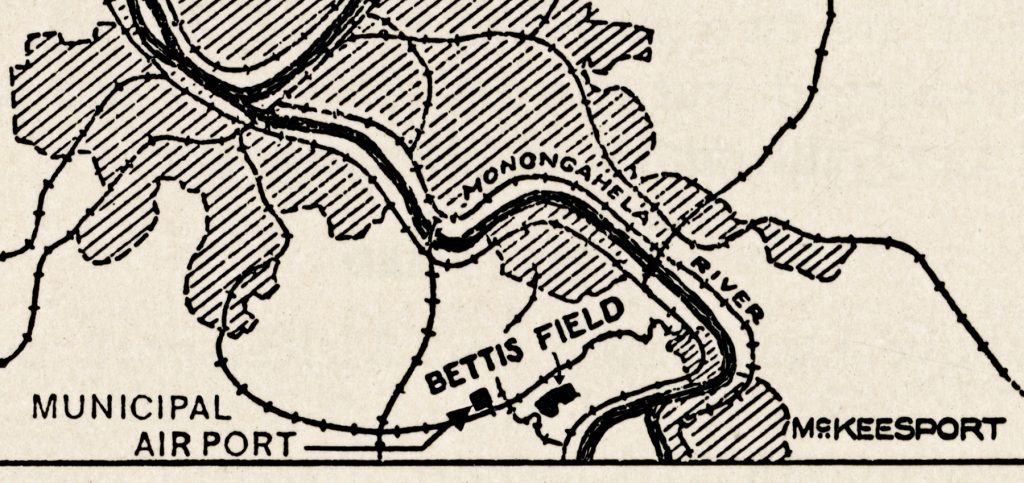
This excerpt from a 1930 map shows the two airfields in Allegheny County that Katherine Baker provided airport and in-flight catering for. Pittsburgh Commemorating the Fiftieth Anniversary of the Engineers Society of Western Pennsylvania, 1930.
With her establishment situated just west of two airfields, Kitty was soon catering meals to both sites and feeding those workers who showed up at her door calling her either “Ma” or “Lady” Baker. “Now I seem bound by the sky,” she told the Press in a May 1935 article headlined “She’s ‘Lady Baker’ To Pilots Who Travel From Coast to Coast.” Kitty was thoroughly immersed in aviation:
I know all the pilots, am used to their shop talk, and am just as fussy about weather conditions as they are. I have to be, you know. If the weather is bad, and they’re staying over, I’ll have to prepare lots more food. I know every ship that flies over the field.… You can tell them by the noise the motors make when you get to know them as well as I do.
When Central Airline launched five “luxury service” round trips per day in July 1935 between Washington and Detroit, with stops in Pittsburgh and Cleveland, it was Kitty who supplied the luxuries aboard the new Stinson plane. She provided a full-course, white-tablecloth luncheon on the christening flight piloted by noted Pittsburgh pilot Trow Sebree and famed McKeesport aviatrix Helen Richey, the first woman hired as a pilot on a commercial airliner.
In June 1936 Kitty assumed management of the restaurant at Allegheny County Airport, a move that gave her “far famed corn fritters, spiced fruit and pecan pie a new locale.” It was a short-lived experiment for Kitty, as airports were expensive to run, and income from high turnover/low overhead concessions like casual restaurants and coffee shops provided important revenue. Concession contracts were hotly contested as lucrative business opportunities, and Kitty was soon pushed out. But by 1937, she was preparing more than 60 boxed lunches per day for coast-to-coast TWA flights. She shared some of her in-flight catering tips with the Press:
Fowl – chicken, squab, duck – are ideal foods, but fish is absolutely “out.” Most fruit juices and prepared fresh fruit add taste to the lunch, but bananas are ruled against – unless you want the entire lunch box to have a banana flavor.… The cheese list is also limited, Mrs. Baker says. A mild cream cheese has proved a favorite. On the ground man may like a pungent bite with their favorite lager, but in the air they prefer a more dainty morsel.
Kitty even sent homemade ice cream aloft for short flights.
She continued to provide meals at the smaller Bettis Airfield into the 1940s, first at the terminal’s former equipment building and then at a private home across the road, which Pittsburgh Institute of Aeronautics took over for a wartime dormitory. But Kitty’s in-flight catering business couldn’t keep pace with demand as the volume of commercial flights grew. In 1940, TWA announced a $5,000 “passenger kitchen” to prepare special airline foods in the Fliers’ Club building opposite AGC, which was renovated to house flight crews during stopovers. The club facilities provided more than 300 hot meals for passengers per day.
High volume and impersonal service were not Kitty’s style. She moved to Canonsburg, Washington County, in the 1940s to open a tearoom called Baker Farm. Many of the loyal Pittsburgh aviation crowd followed her there for luncheons, dinners, and parties until she passed away at the age of 71 in 1950. This busy little woman, who went from Iowa farm fields to Broadway chorus lines and the cockpits and cabins of the new aviation age, single-handedly set standards for in-flight dining that today’s highly salted and preservative-laden prepackaged airline meals fall far short of.
About the Author
Sue Morris is a freelance regional historian and the co-author of the Heinz History Center’s book “Bettis: Where Pittsburgh Aviation Took Off” with Brian Butko. For more about Kitty Baker and early aviation food service, check out the full story at Sue’s blog, The Historical Dilettante.