
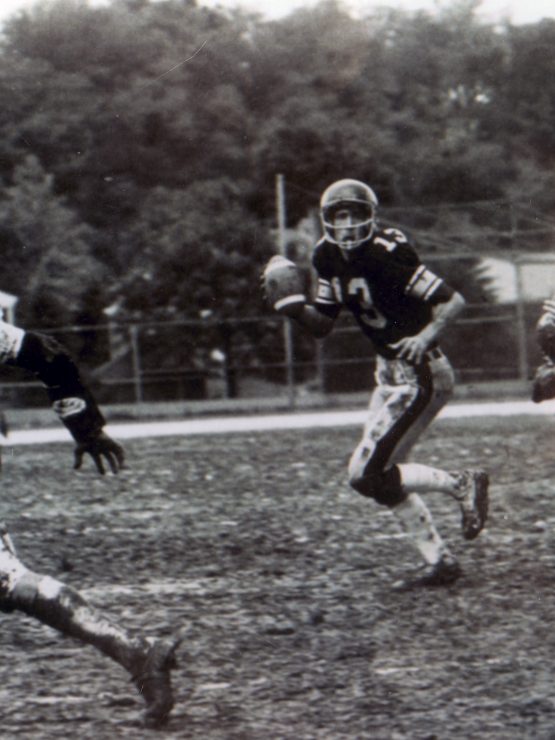
It goes back a long way, this tradition of quarterbacks as a natural resource in western Pennsylvania.
-Roy McHugh, The New York Times, 1991
The list of professional quarterbacks who hail from Western Pennsylvania is long. It includes six Hall of Famers, a Heisman Trophy winner, record setters, and a noted barrier breaker. Shaped by a football culture centered on competitive excellence, they spent their Friday nights on hometown fields, honing the skills that would lead them elsewhere. All of them eventually made it to the pros: the NFL, CFL, or Arena League. They forged a legacy that dates to the 1940s, when this region first began to be noted as a birthplace of greatness, the cradle of quarterbacks.
Even the Pro Football Hall of Fame is unsure about who first coined the term “cradle of quarterbacks,” but no scholar of football history can argue that it is not accurate.
The names of some of Western Pennsylvania’s local Hall of Famers —George Blanda, Johnny Unitas, Joe Namath, Jim Kelly, Dan Marino, and Joe Montana—are well known. While all share this birthplace, each has characteristics that make them distinctive.
George Blanda (1927 – 2010)
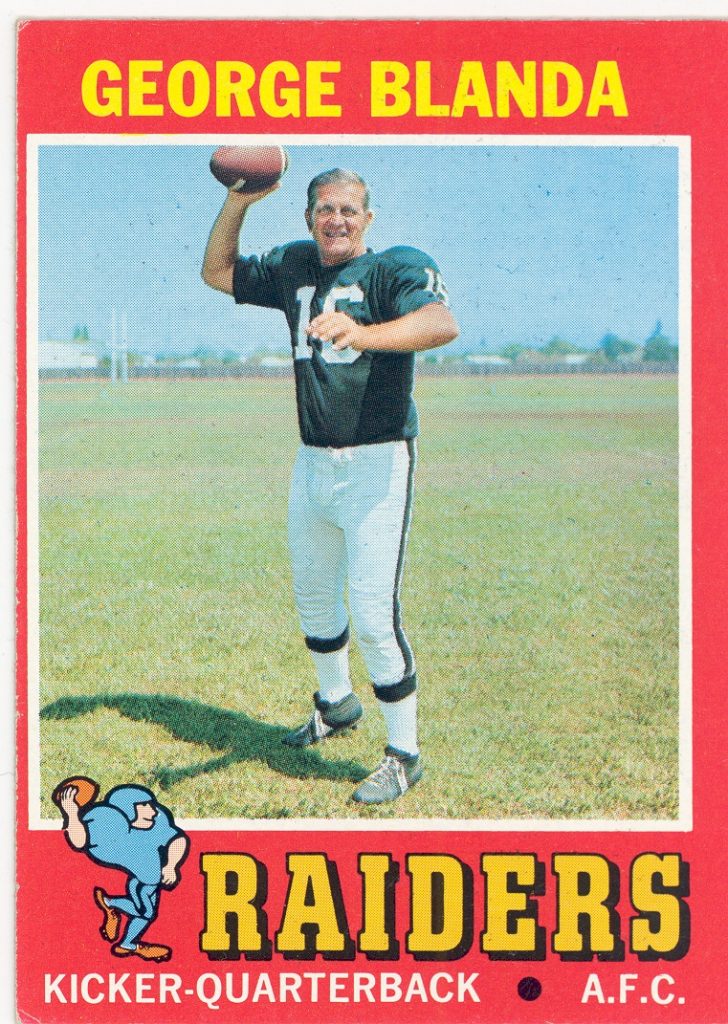
George Blanda, Topps trading card, 1971.Pictured here at age 44, Blanda no longer quarterbacked the team, but still added points to the board as a kicker for the Oakland Raiders. Gift of Marty Rosen.
George Blanda made his mark as a resilient gunslinger, one of only two men to play professional football over four decades. Born in Youngwood, a small town in Westmoreland County now home to about 3,000 people, Blanda grew up tough like his father, a coal miner. One of seven boys, he often contended that he ranked only third or fourth in his own family in terms of athletic talent. None of the Blanda boys however could have rivaled George for sheer desire; his career clearly speaks to his love of the game and his force of will.
A quarterback, kicker, and linebacker at Youngwood High School, Blanda played his college ball at the University of Kentucky for legendary coach Bear Bryant, who would later shape the career of fellow regional quarterback Joe Namath at Alabama. After college, Blanda signed a $6,000 contract with the Chicago Bears. Three quarterbacks already anchored George Halas’ Bears: future Hall of Famer Sid Luckman, Heisman trophy winner and Western Pa. native Johnny Lujack, and future Steeler and Hall of Famer Bobby Layne.
Though Blanda would outlast them all, his relationship with Halas was strained and he retired from pro football in 1959. The advent of a new league, the American Football League, led to the second chapter of his pro career. Blanda signed with the Houston Oilers in 1960 and brought them two AFL titles in his first two years. Named AFL Player of the Year in 1961, his record 36 touchdown passes that season would not be eclipsed until Pittsburgh’s Dan Marino recorded 48 in 1984.
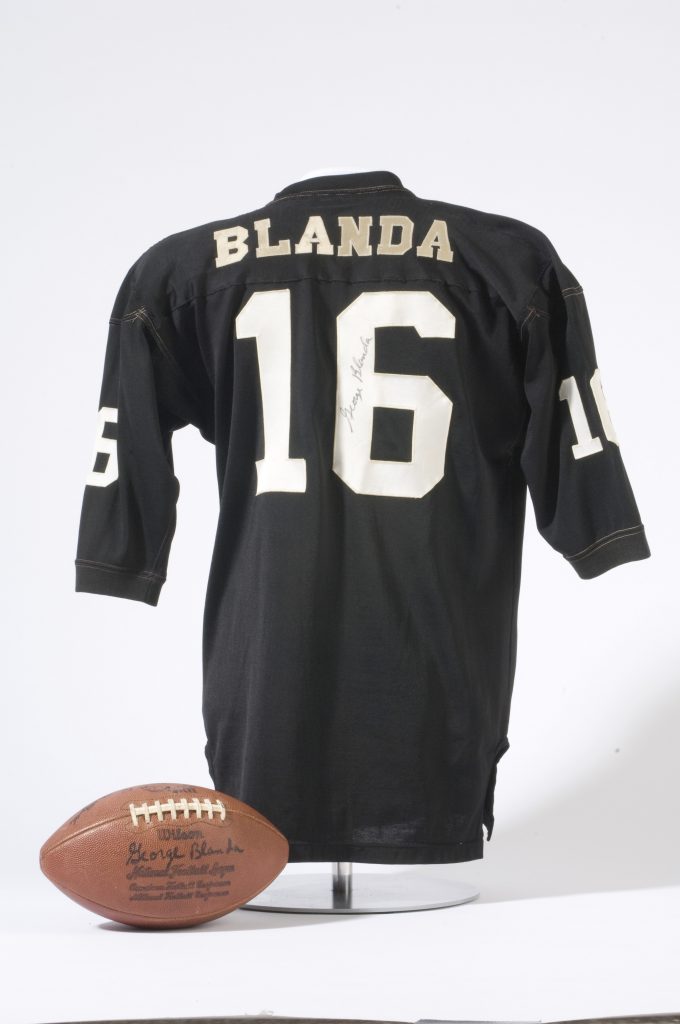
George Blandas 2000 Points — When quarterback/kicker George Blanda retired in 1975 after a 26-year career with five different teams, he was just one month shy of his 49th birthday. At the time of his retirement, his 26-seasons and 340 games played were NFL records as was his 2,002 career points scored. This is the jersey the ageless wonder wore on December 21, 1975 and the ball he kicked that day for his 2,000th career point.
Blanda’s career seemed over when the Oilers released him in 1967, but the third, and perhaps most amazing chapter had just begun. Signed by the Oakland Raiders, Blanda continued to compete as both a quarterback and a kicker. In 1970, he came off the bench in five straight games to engineer come from behind wins for Oakland—throwing touchdown passes, and in one instance booting a 53-yard field goal to seal the win. At age 43, he won the Bert Bell award for his astounding achievements. Blanda added five more seasons as the Raider’s kicker.
In his last game, played fittingly enough at Three Rivers Stadium against the Pittsburgh Steelers on Jan. 4, 1976, he notched a 41-yard field goal and added an extra point as the Raiders fell 16-10 to Pittsburgh in the AFC Championship game. Blanda’s career was as straight-ahead as his kicking style, a record 26 seasons in the pros, with 2,002 points scored. Inducted into the Hall of Fame in his first year of eligibility, 1981, he remains the oldest player at 48 years and 109 days, to play the game.
Johnny Unitas (1933 – 2002)
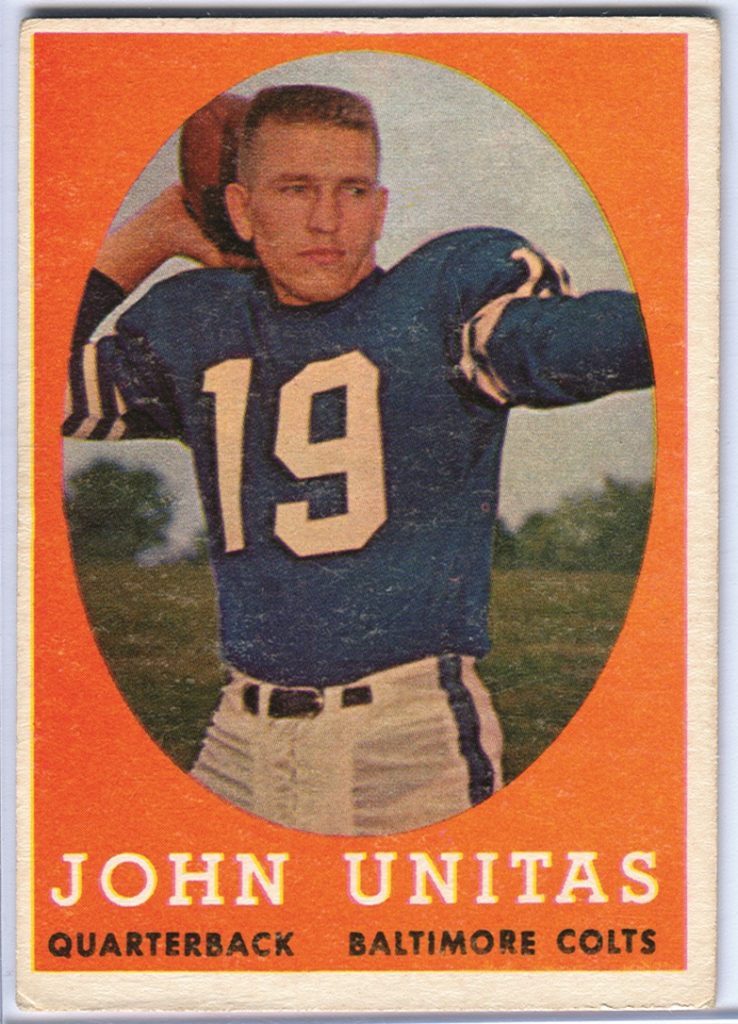
Johnny Unitas, Topps trading card, 1958. Unitas led the Colts to an NFL championship in 1958, beating the Giants 23-17 in sudden overtime in a game some refer to as the greatest ever played. Gift of Katie Morrell.
Now considered one of the greatest players of all time, at key junctures in his career, it seemed that Unitas might never play pro ball. The child of Lithuanian immigrants, Unitas’ father passed away when he was just four years old. His mother raised him in the Brookline neighborhood of Pittsburgh and Johnny attended tiny St. Justin’s High School. He played halfback and quarterback in football, beating out North Catholic’s quarterback Dan Rooney for first team Catholic League all-star honors. Though he stood over six feet tall, Unitas reportedly weighed only 145 pounds and major college programs such as Notre Dame passed on him as a recruit.
Unitas attended the University of Louisville where he started four games as a freshman and generated 602 passing yards. Beginning in his sophomore year, he played both ways, also returning kicks and punts on special teams. Though his passing stats were impressive, the team struggled, and Unitas sat out part of his senior season with an injury. Drafted by the Steelers, Unitas never took a snap in training camp, and was released before the season started.
Low on resources, Unitas lacked the cash to head north to Canada and try his luck in the CFL. A fellow Louisville teammate, Fred Zangaro invited him to join the semi-pro Bloomfield Rams. Playing on Arsenal Field in Lawrenceville for $6 a game, Unitas helped the team put together a winning season and capture a 1955 Steel Bowl Conference championship.
The following season, Unitas had a tryout with the Baltimore Colts. Though some had thought him too small or not bright enough to run a pro offense, Coach Weeb Ewbank saw a hunger in Unitas that he liked. He said, “This was a kid who wanted success and didn’t have it for so long that he wasn’t about to waste it when it came.”
Unitas got his chance to prove the naysayers wrong when the Colts’ starting quarterback went down with an injury. Though he lost his debut game, he threw nine touchdown passes that year, including one in the season’s finale that started his record 47-game win streak. Unitas’ 55.6 percent completion mark was a rookie record.
He would lead Baltimore to three championships in 1958, 1959, and in Super Bowl V, and be named Player of the Year or MVP three times. Named the greatest player in the first 50 years of Pro Football, Unitas was inducted into the Pro Football Hall of Fame in 1979. Second guessed along the way, he never doubted himself and became known for his icy confidence and big playmaking skills.
Joe Namath (1943 – )
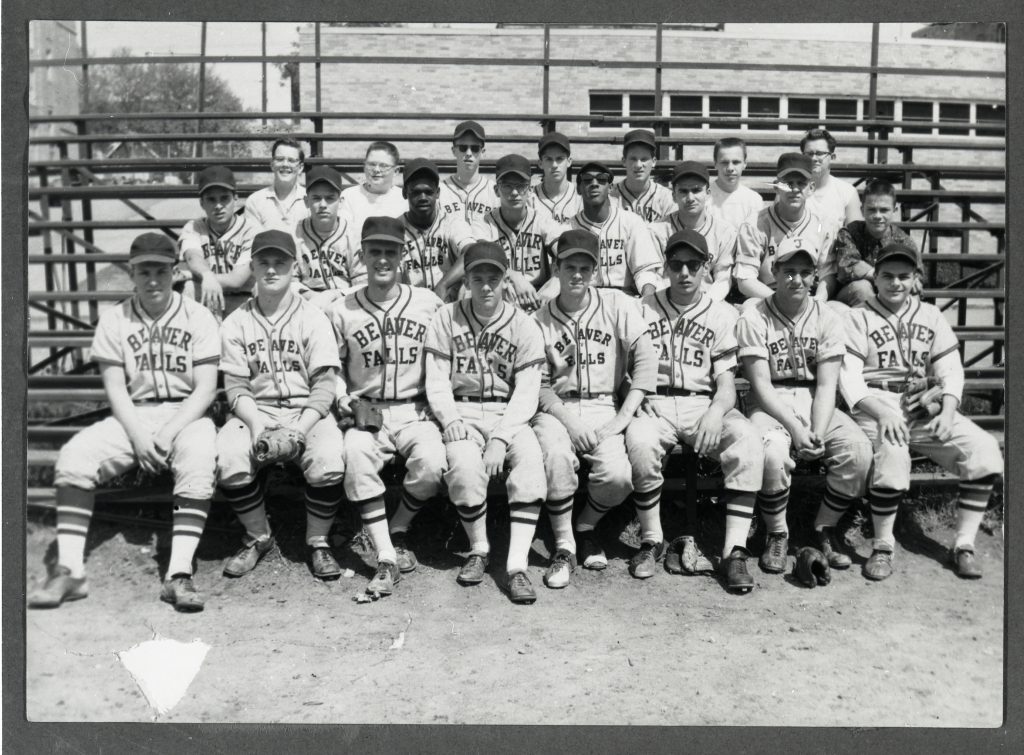
Joe Namath and Beaver Falls baseball team, c. 1960. An all-around athlete, Namath (here in sunglasses), perfected his Broadway Joe persona before arriving in the pros. Gift of Larry Bruno.
Beavers Falls’ own, Joe Willie Namath, might be one of the few to ever get the better of Johnny Unitas. In 1969, the brash, young Jets’ quarterback guaranteed a victory over the Baltimore Colts in Super Bowl III. And as he had done many times before, Namath delivered on his promise, leading the Jets to a 16-7 victory over Unitas and the Colts.
The grandson of Hungarian immigrants, Joe grew up in the steel and glass company town of Beaver Falls. He excelled at football, basketball, and baseball in high school, carrying himself with confidence, even at a young age. Recruited by major league baseball teams, he instead chose to attend the University of Alabama, where he played for Bear Bryant. Though he and Bryant often disagreed, there was great respect in the relationship, with Bryant calling Namath “the greatest athlete I ever coached.” Namath led the team to a national championship in 1964 and achieved a 29-4 record in his three seasons at the helm.
Drafted by both the NFL and AFL, Namath chose to sign with the New York Jets for a then record $427,000. Considered by many to be sport’s first superstar, Namath thrived in New York, earning the nickname “Broadway Joe.” Named the AFL Rookie of the Year in 1965, he became the first professional quarterback to pass for more than 4,000 yards in 1967. His talent was showcased in the first Monday Night Football ever telecast on September 21, 1970 and his promotional work and private life made him a media regular.
Namath had another memorable meeting with his boyhood hero Johnny Unitas. Playing in Baltimore on September 24, 1972, the two combined for 872 passing yards. Namath racked up an incredible 496 yards and six touchdowns in a 44-34 victory, New York’s first victory over Baltimore since Super Bowl III. In that same game, Unitas threw for 376 yards and three touchdowns. Many consider this to be the finest exhibition of passing in a single game in NFL history. Plagued by knee injuries, Namath retired after one season with the Rams in 1977 and was inducted into the Hall of Fame in 1985.
Joe Montana (1956 – )
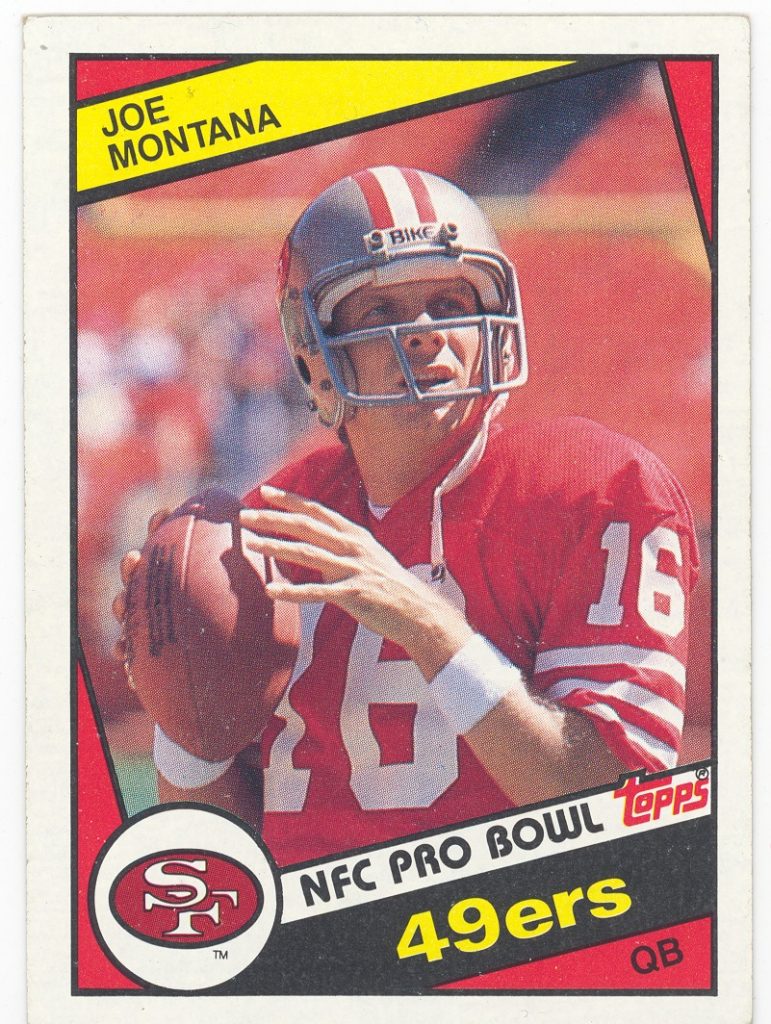
Joe Montana, Topps NFC Pro Bowl trading card, 1984.Named to eight Pro Bowl teams, 1984 was also one of the five years in which Montana led the NFC in passer rating.
This New Eagle native became the master of the late-game comeback, a skill formed through countless sessions threading the ball through a tire in the back yard, just as his idol Terry Hanratty of Butler had done. Growing up in Monongahela, Montana attended Ringgold High School. Though his Dad taught him the game of football at a young age, basketball was his favorite sport. An all-state player in 1973, he helped the team win the WPIAL AAA championship. A baseball standout as well, Montana did not start for the football team until his junior year. But he played well enough to be recognized as a Parade All-American and to earn a scholarship to Notre Dame, just like Hanratty.
It was there that Joe flourished, his skill and confidence molding him into a leader who found a way to win, no matter the score or how little time remained on the clock. But many pro scouts discounted his national championship and his talents. The San Francisco 49ers took a chance on Montana, drafting him at the end of the third round. Four Lombardi trophies prove they made the right choice—Montana built a career on delivering, including a 92-yard drive in the closing seconds of Super Bowl XXIII for the win.
Named the MVP of three of those Super Bowls, Montana remained a winner throughout his career. In his final season with the 49ers in 1992, after missing 31 games with an injury, he put together a second half that included completing 15 of 21 passes for 126 yards and two touchdowns as the 49ers defeated the Lions 24-6 in a Monday night game. Montana retired after the 1994 season with the Chiefs and went into the Hall of Fame as a member of the class of 2000. He never doubted that the fundamentals he learned in his own backyard could carry him as far as he wanted to go in football.
Jim Kelly (1960 – ) and Dan Marino (1961 – )
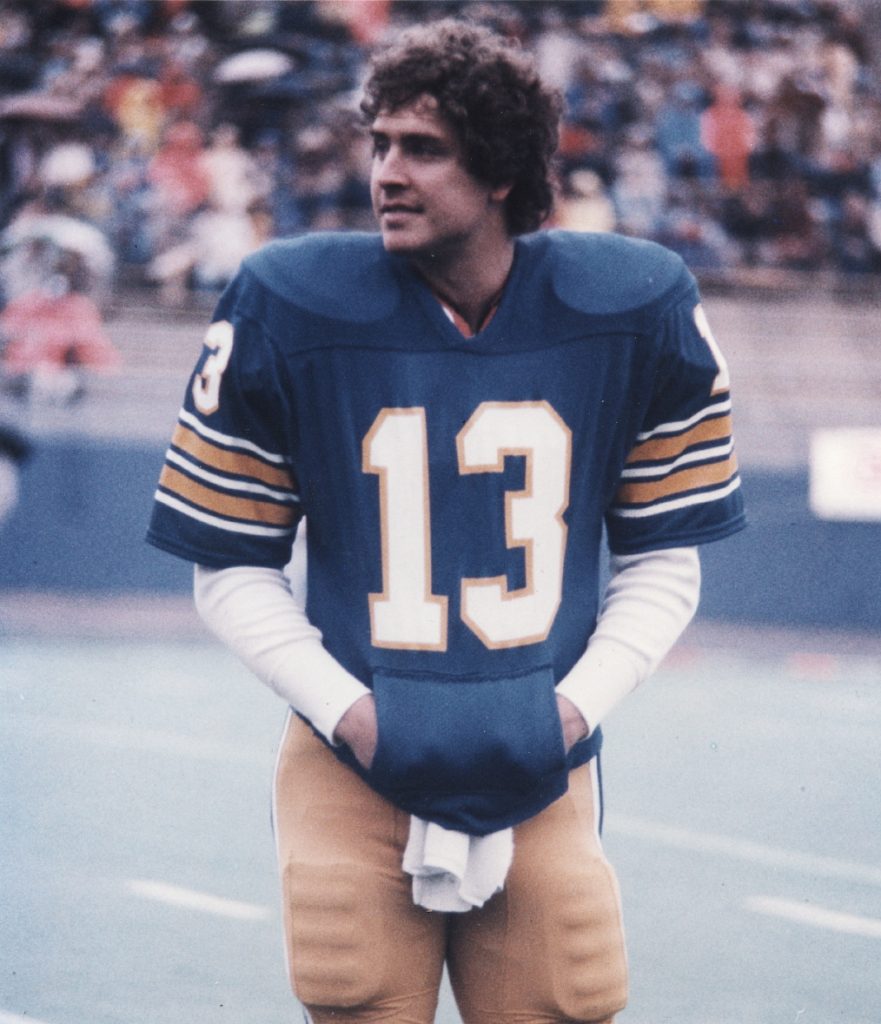
Dan Marino at University of Pittsburgh, c. 1980. Marino had an All-American career at Pitt—in his junior year he connected for 37 touchdown passes. Courtesy of University of Pittsburgh.
Both members of the 1983 draft class, these quarterbacks were multi-sport standouts in high school. Kelly, who grew up in East Brady, won all-state honors in football his senior year, but also scored 1,000-plus points on the way to a state semifinal berth in basketball. Recruited heavily by Penn State, he chose the University of Miami, then turned around and beat Penn State in his first game as a starter.
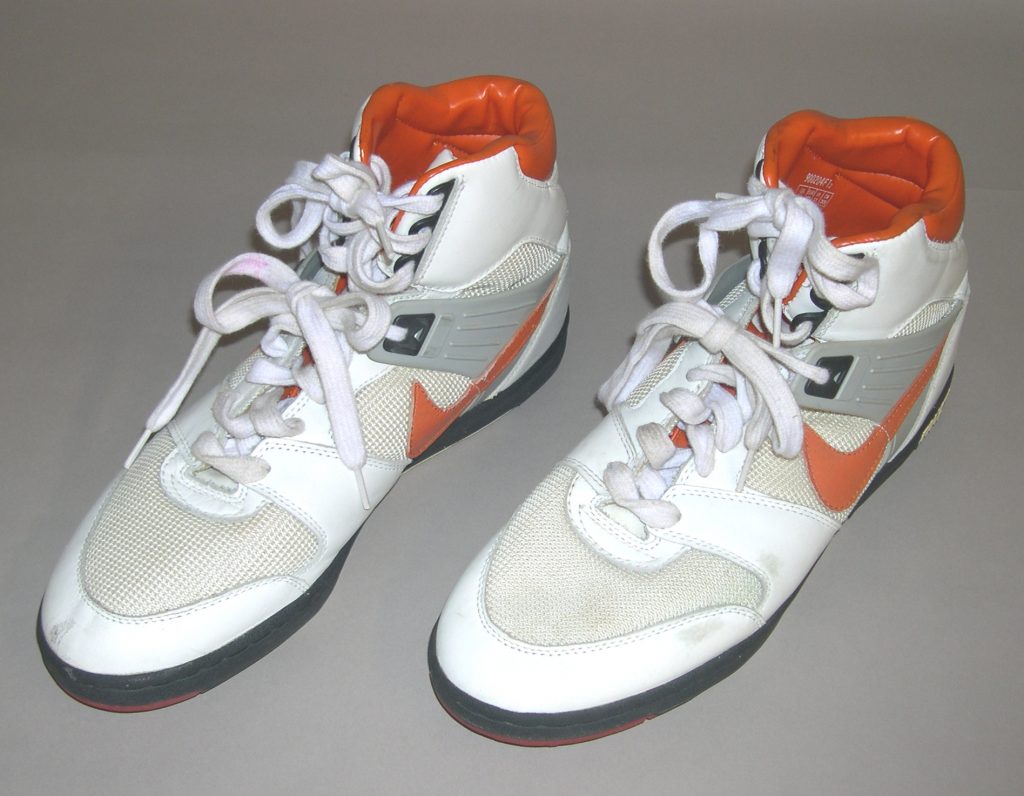
Shoes worn by Dan Marino, 1995. On Nov. 12, 1995, Marino broke the NFL record for career passing yards when he eclipsed Fran Tarkenton’s mark of 47,003. He became the first quarterback to pass for more than 60,000 career yards. Gift of Dan Marino Enterprises, Inc.
Marino, a standout baseball player drafted by the Kansas City Royals, also received Parade honors for his football feats at Central Catholic High School. Marino chose to stay close to home, attending the University of Pittsburgh. His strong arm led the Panthers to a last-minute win over Georgia in the 1982 Sugar Bowl when he fired the game-winning pass to tight end John Brown with less than a minute remaining. Slowed by injuries, Marino did not have as strong a senior year, losing the Cotton Bowl 7-3 and dropping to ninth in the Heisman Trophy voting after ranking fourth his junior year.
Though both first-round choices, Kelly went higher in the NFL draft, chosen as the 14th pick by Buffalo. Passed over by Chuck Noll and the Steelers, Marino was chosen as the 27th pick by Miami. It proved to be a great match—though he never won a Super Bowl, Marino retired in 1999 holding or having held almost every NFL record that existed. He was inducted into the Hall of Fame as a first ballot selection in 2005.
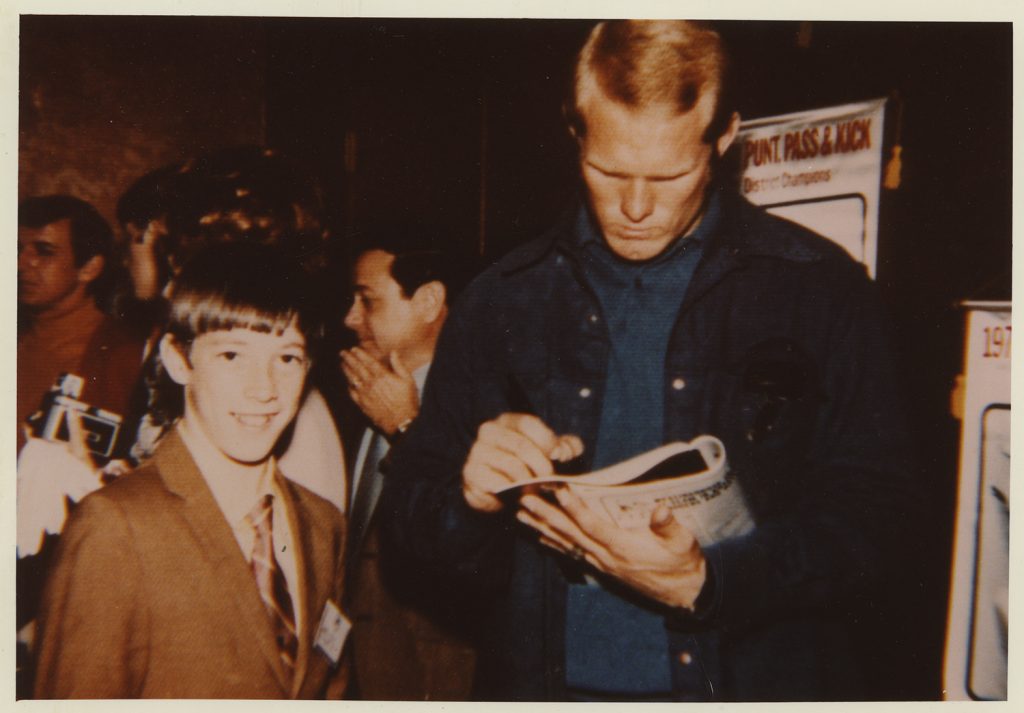
Jim Kelly and Terry Bradshaw, c. 1971. Kelly achieved success in football early on, winning the punt, pass, and kick championship, then going on to pass for almost 4,000 yards at East Brady High School. Gift of Jim Kelly enterprises.
Kelly chose the USFL for the start of his pro career, playing for the Houston Gamblers. Wearing the number 12, in homage to his boyhood hero Joe Namath, he threw for almost 10,000 yards in just two seasons. When the League folded in 1986, he went to the Bills, eventually leading the team to four Super Bowls. The no-huddle offense that he had pioneered in the USFL became a trademark with the Bills. Kelly finished his career with more than 45,000 pro passing yards and 320 touchdowns and joined the Hall of Fame with the class of 2002.
What accounts for this rich level of talent? Johnny Unitas thought it was because of “Toughness, dedication, hard work, and competitiveness; a no- nonsense, blue-collar background.” These quarterbacks are all deeply rooted in their communities, most with a strong first or second generation ethnic heritage. As on-field leaders they benefited from the knowledge imparted by skilled coaches and from the example set by those who went before them. Just as Dan Marino and Joe Kelly talk about watching Joe Namath play when they were young, so too did Joe Montano look up to Terry Hanratty. And so too, do these Hall of Famers inspire a new generation.
In addition to strong, centered families, quality coaching, and a tradition of greatness, local players received remarkable community support. They became part of a sporting tradition that knit communities together, focusing energy on Friday night contests, some of which pit rivals that have faced off for decades. Quarterbacks became the most visible manifestation of this culture, a culture that valued football and recognized that it provided a means to escape the mill, receive an education, and achieve success.
The breeding ground for these quarterbacks, and the dozens of others born here, spans the region. Many trace their lineage to the region’s mill towns where the ethos of high school football reflected the ethic of hard work and dedication that made this area the world’s steel capital. Boys such as Arnold Galiffa from Donora, Gus Frerotte from Ford City, Babe Parilli from Rochester, Chuck Fusina of McKees Rocks, or Charlie Batch of Homestead. Or Willie Thrower of New Kensington, the first black quarterback in the modern NFL. He broke the color barrier at quarterback in the Big Ten, playing for Michigan State, then in the NFL when he took the field for the Chicago Bears on Oct. 18, 1953.
Others grew up in Pittsburgh, playing for the city and Catholic schools that dot the downtown neighborhoods—Major Harris at Brashear, Johnny Unitas from little St. Justin’s, and Bruce Gradkowski of Seton-LaSalle, who was asked in high school by a reporter, “How do you feel about being in the same league as some of the best quarterbacks to play the game?” and replied “Hope is a good thing, and no good thing ever dies.” Still others came from small towns, George Blanda from Youngwood and Jim Kelly from East Brady. Steel towns or downtown, all share a lineage that leads back to Western Pennsylvania. Collectively, they put this region on the national football map.
About the Author
Anne Madarasz is the director of the Franco Harris Sports Museum and chief historian at the Heinz History Center.