
In the days following the 1972 draft, the sports pages in Pittsburgh newspapers used words such as “skepticism” and “surprise” when talking about the Steelers’ first-round pick: Franco Harris.
By Christmas, those doubts were gone. Franco Harris had become an immaculate gift, one that kept giving for years to come.
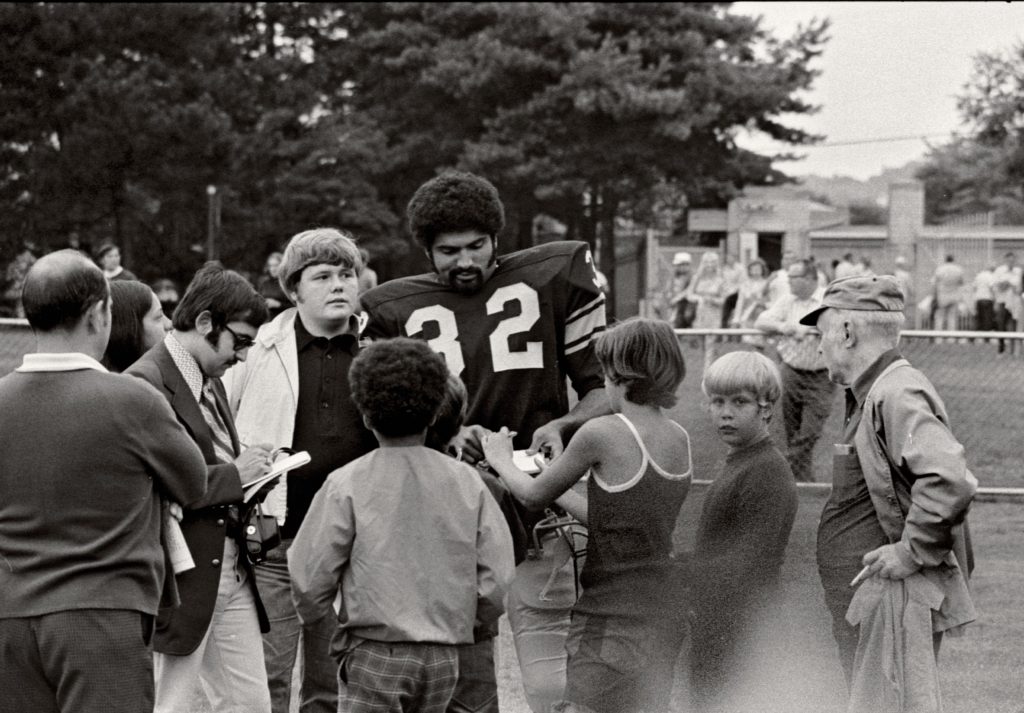
Franco Harris signs autographs at training camp, 1972. Pittsburgh Steelers.
A standout three-sport athlete at Rancocas Valley High School, Harris’s naming by Kick-Off Magazine as one of the best 44 players in the country after his junior year brought attention and college offers. He chose to attend Penn State, becoming a three-year letterman for the football team.
His teammate and fellow running back, Lydell Mitchell, got more attention, but Harris still generated strong numbers as a blocking back and played an important role in the Nittany Lions’ 29–4 record from 1969 to 1971. Harris rushed for 643 yards in his sophomore season and scored 10 touchdowns. Watching highlights from the 1970 Orange Bowl, where Penn State defeated Missouri 10–3, you can see his powerful running style and his ability to shake off defenders and chew up yardage.
In his junior year, Harris gained 675 rushing yards and then 684 his senior year for 2,002 career rushing yards and 24 touchdowns. With solid hands, he also caught 28 passes for 352 yards and a touchdown. Chosen to play in both the Senior Bowl and the Chicago College All-American game, Harris did not excite the scouts who journeyed to watch the top college prospects practice.
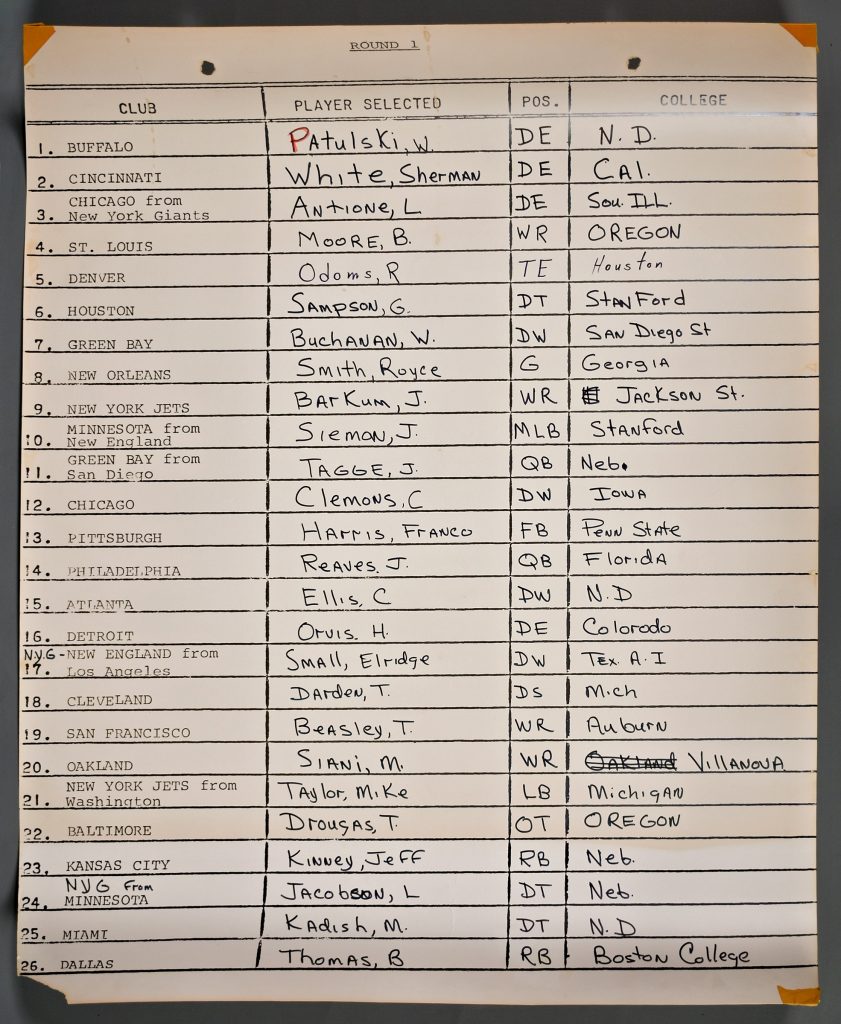
Board used by Pittsburgh Steelers to keep track of first-round draft choices, Feb. 1, 1972. This simple piece of paper with handwritten notations demonstrates how much the process of draft day has changed since 1972. Courtesy of Pro Football Hall of Fame.
Coach Chuck Noll spent a week in Mobile and said flatly that he was “not particularly impressed” by Harris. However, when film arrived of the Senior Bowl game, the Steelers saw something new. Harris, who scored two touchdowns in that game, demonstrated an ability to break tackles and move through defenders. Bigger and more athletic than Lydell Mitchell, the Steelers placed him on their draft board, claiming him #13 overall in the first round of the 1972 draft.
Concerns continued in training camp, where Harris failed to impress his coaches and teammates. After two weeks, offensive backfield coach Dick Hoak recalled, “we thought maybe we had a dud.”
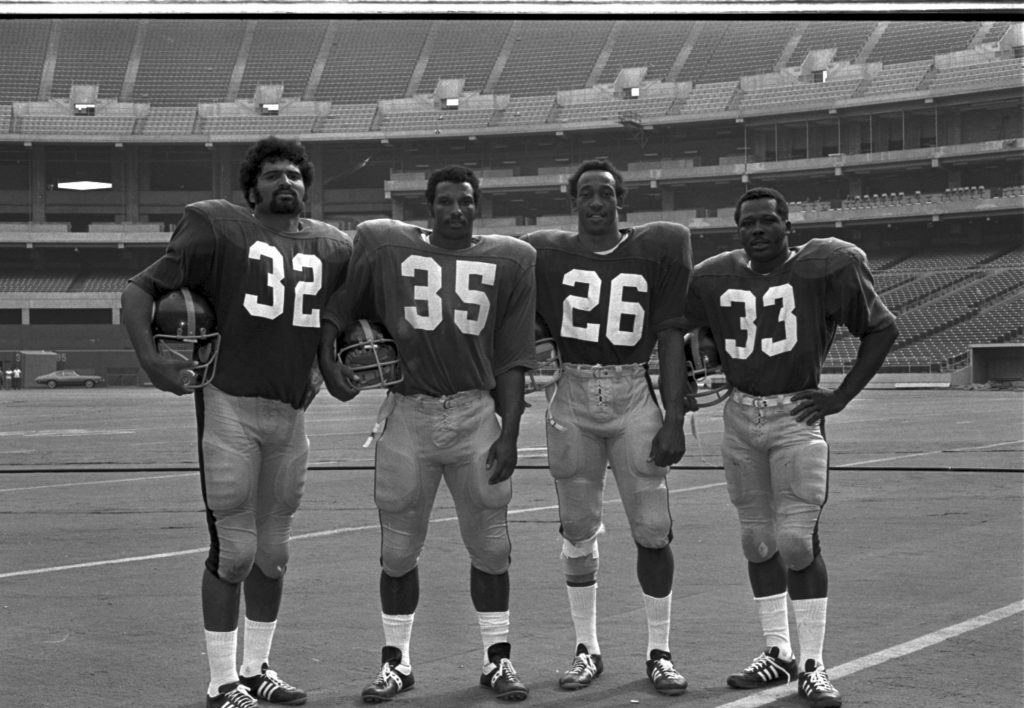
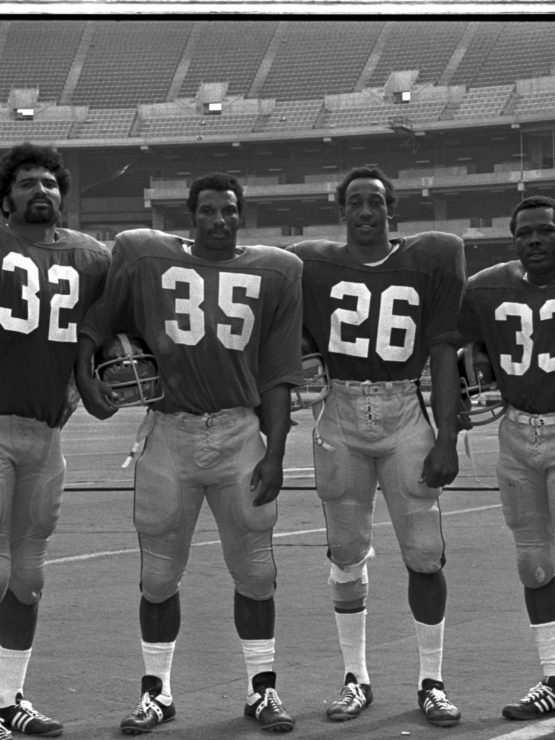
Franco Harris, far left, with Steelers veteran running backs Steve Davis (35), Preston Pearson (26), and John Fuqua (33), 1972. This image demonstrates why the Steelers drafted Harris in 1972 — his size, his power, and his quick footwork were important assets to the team. Pittsburgh Steelers.
But then Franco broke it open for a 76-yard touchdown against Atlanta in a preseason matchup. By November of the 1972 season, Hoak was proclaiming, “He’s amazing. As far as running with the football, there’s no way he can get better.”
But he did get better. That rookie season brought the NFL Offensive Rookie of the Year award and, of course, the Immaculate Reception. Four Super Bowl victories and a place in the Hall of Fame followed.
Both during his career and after football, Harris embedded himself in the Pittsburgh community, embracing an army of fans and charitable work focused on children’s health, nutrition, and education, as well as social justice and equality. He became one of football’s and Pittsburgh’s most recognized and beloved citizens.
Revered during his playing career and after, Franco’s name can be found in places as varied as the Franco Harris Pittsburgh Center at Penn State, at Acrisure Stadium where his retired jersey hangs, on Franco Harris Way in his hometown of Mount Holly, New Jersey, and on the Franco and Dana Harris Scholars program of the Pittsburgh Promise. The iconic Immaculate Reception life figure created by the History Center greets millions of travelers every year at the Pittsburgh International Airport.
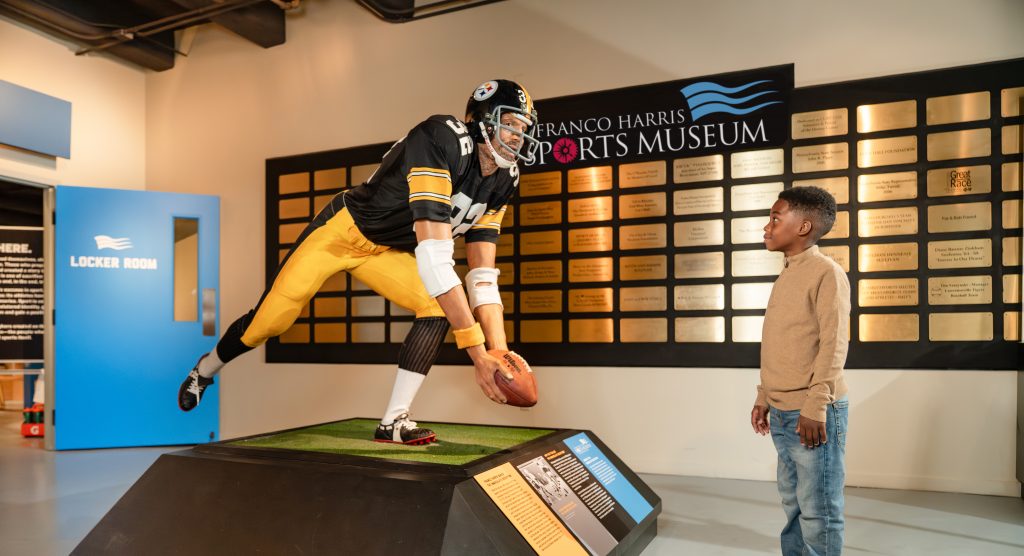
A young visitor at the entrance of the Franco Harris Sports Museum.
Now the Sports Museum at the History Center bears his name as well, recognizing the 20-plus years Franco led the Champions Committee and dedicated his time and effort to the institution.
The Franco Harris Sports Museum honors a man who was integral to building the Sports Museum and who inspired us to chart a new path for the future. Franco exemplified the best of what sports can be, and this renaming has allowed us to imbue the museum with the characteristics that he embodied.
As a rookie, Franco said, “Wherever I go to play, I want to live in that city and get involved in that city, become that city.”
He reminds us that we can all build a life of purpose and meaning. We are honored to share Franco Harris’s life story, his football story, and his legacy, and hope that it inspires others in the years ahead.
About the Author
Anne Madarasz is the director of the Franco Harris Sports Museum and chief historian at the Heinz History Center.