
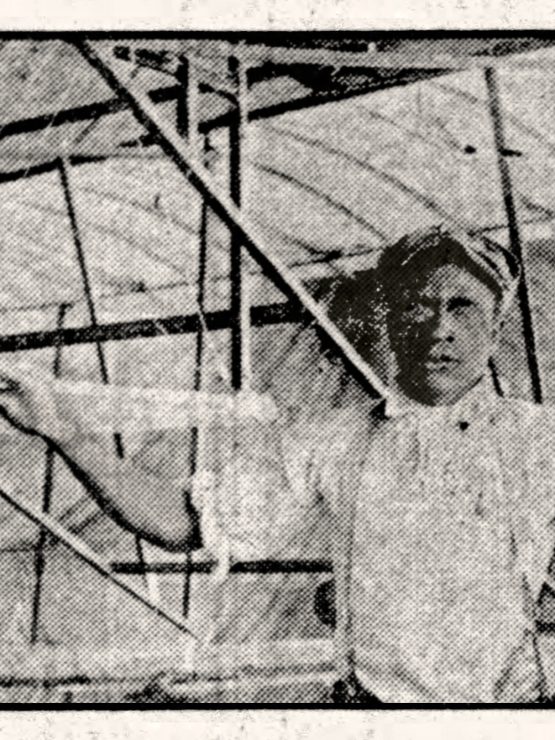
Like many in the wake of the Wright Brothers’ successful flights, Hill District resident Charles Wesley Peters was fascinated by the wonders of aviation. Using his mechanical skills, in 1906 he built and sailed a glider near the Herron Hill Water Basin when he was just 17. By the time he was 21, he was flying short distances in the Hill in his personally designed 40-foot-long flying machine powered by an air-cooled automobile engine. Working in a local auto repair shop gave Peters access to parts and equipment.
Flight itself was still a novelty, let alone when accomplished by a Black man, so in 1911 newspapers across the country documented Peters’ achievements by publishing a photo of him posing with his biplane. Claims as to the first Black pilot usually list Turkish aviator Ahmet Ali Çelikten receiving his wings in 1914, or Georgia-born Eugene Jacques Bullard flying for the French Air Service in 1917 during World War I. Although these two may have more documentation, the newspaper trail is clear: Peters flew before them, not only as a pilot but also as a builder of his own craft.
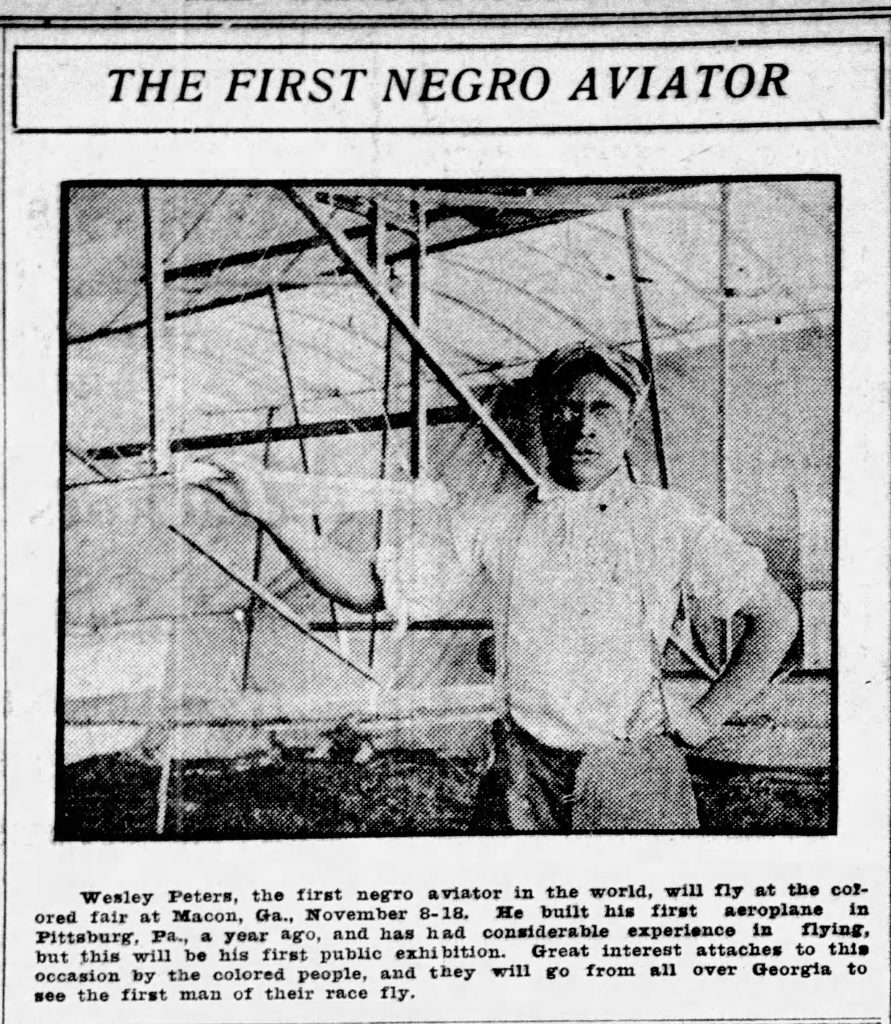
Charles Wesley Peters made national news in 1911. Atlanta Journal, October 16, 1911.
The media publicity around Peters led to an invitation later in 1911 to display and fly at the fifth annual Georgia State Colored Fair, a Black-led celebration designed to promote cultural accomplishments and racial pride. The Macon Telegraph wrote that fair president Major Richard R. Wright Sr. invited Peters after making “a trip east in search of a negro aviator and he finally found one at Pittsburg, PA., and it is claimed that this negro is the only aviator of that race in the country.”
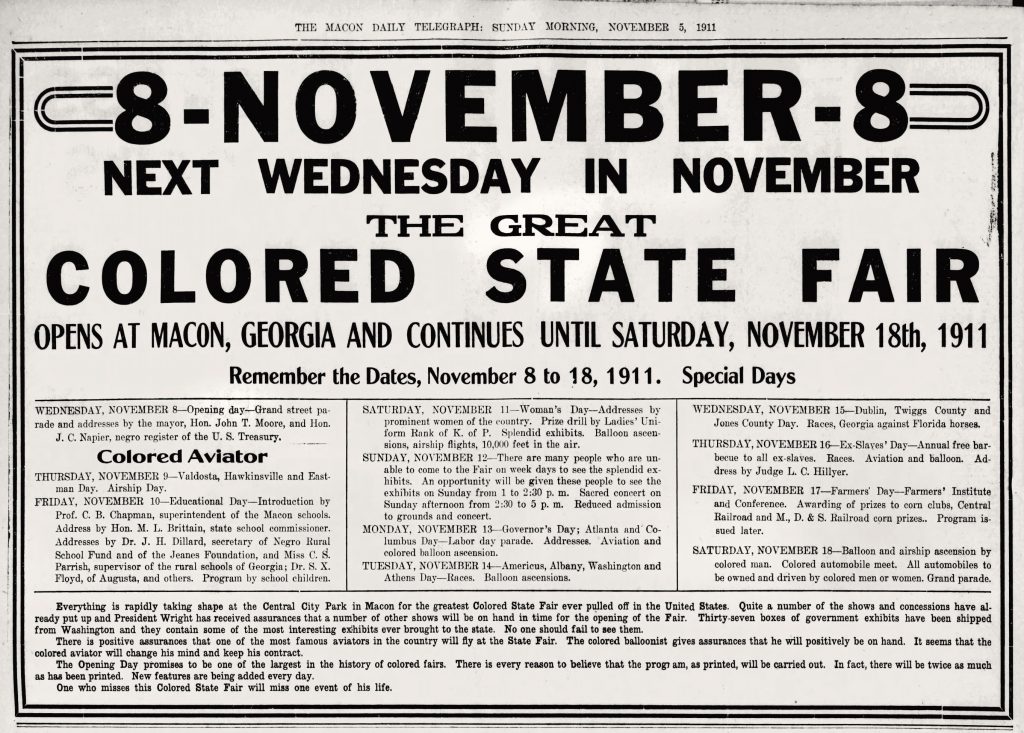
Uncertainty about whether Charles Wesley Peters would appear at the 1911 Georgia State Colored Fair is reflected in the fine print of this ad, published three days before opening day: “It seems that the colored aviator will change his mind and keep his contract.” Macon Telegraph, Nov. 5, 1911.
Peters accepted the plaudits — and the invitation to Georgia. The opportunity must have seemed irresistible, arriving just as Calbraith Perry Rodgers, another Pittsburgher, completed the nation’s first transcontinental flight.
However, Peters and his plane did not make the trip. Reports swirled in Georgia newspapers a week before the fair that Peters was holding out for more money, which he didn’t get. Maybe transportation costs to Georgia were prohibitive for the 22-year-old Pittsburgh auto mechanic. Maybe he was unable — or unwilling — to risk dismantling and transporting his fragile machine. Maybe he even worried that it couldn’t fly as contracted. Or maybe news of a fatal plane crash at the fairgrounds that very same month by a Curtiss Exhibition Team star pilot gave Peters second thoughts about flying there. Whatever his reasons, Charles Wesley Peters ultimately chose not to attend the 1911 Georgia State Colored Fair. After some last-minute searching, an aviator from Atlanta (coincidentally also named Peters, though nothing else is known about him) completed three demonstration flights in a Curtiss biplane.
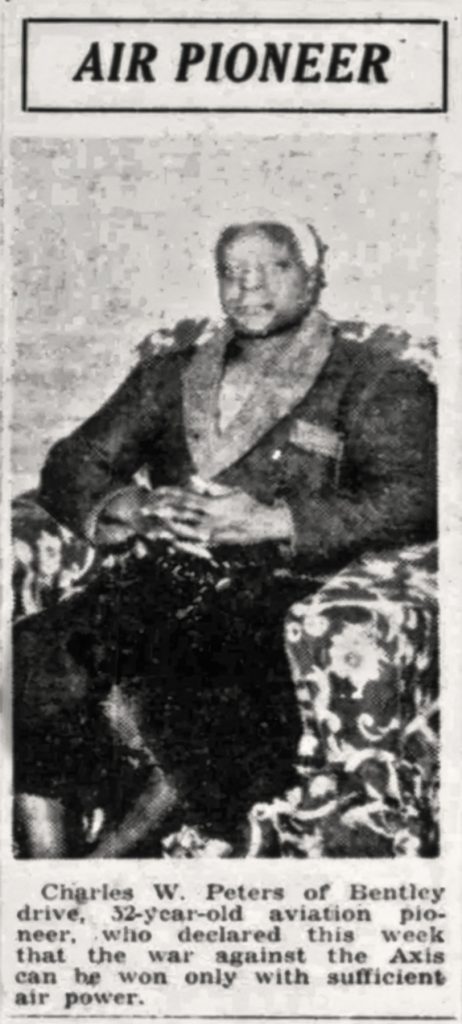
This last known photo of Peters accompanied a 1942 Pittsburgh Courier retrospective of his life. The Pittsburgh Courier, City Edition, Feb. 21, 1942.
Charles Wesley Peters did not pursue further experiments with flight. He told The Pittsburgh Courier in 1942 that a fire destroyed his biplane, and he was unable to raise money to rebuild. Though he never made it to Georgia, Peters did leave Pittsburgh to serve as a private with the 10th United States Cavalry from 1915 to 1920. Created as a segregated all-Black regiment after the Civil War, the 10th Cavalry was one of an initial half-dozen Black units known as “Buffalo Soldiers” primarily led by White U.S. Army officers. Peters’ military career corresponded with conflicts and southern border instability following the 1910 Mexican Revolution. Headquartered at Fort Huachuca in Arizona, Peters was part of the Punitive Expedition dispatched on horseback across the Sierra Madre mountains to capture Mexican rebel leader Pancho Villa and his supporters “dead or alive” while primitive airplanes sputtered overhead to support the military for the very first time.
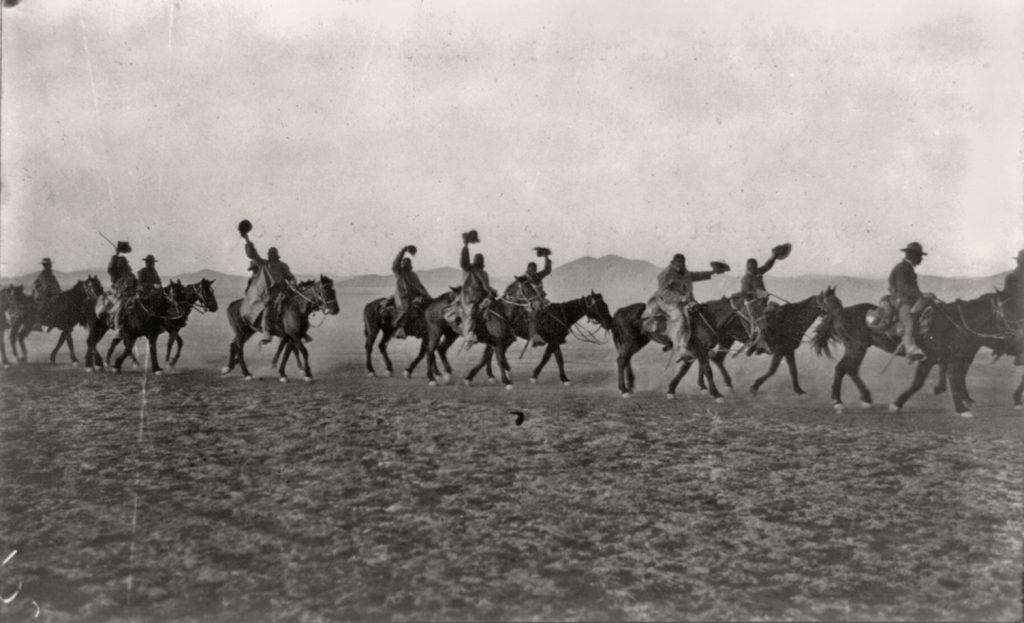
Soldiers of the all-Black 10th Cavalry during the Punitive Expedition to Mexico, 1916. Peters’ lone documented engagement was at the Battle of Aguas Calientes on April 1. Library of Congress.
Peters is acknowledged to be one of Pittsburgh’s aviation pioneers in the Heinz History Center book “Bettis: Where Pittsburgh Aviation Took Off” by Brian Butko and Sue Morris. You can read more about Charles Wesley Peters’ remarkable life and military career in the Summer 2025 issue of Western Pennsylvania History magazine.
About the Author
Regional public historian Sue Morris writes about 19th- and early 20th-century regional social history, urban and aviation history, and is a regular contributor to Western Pennsylvania History magazine. She explores Western Pa. history in her public lectures and blog, Historical Dilettante.