

The recent choice of defensive lineman Stephon Tuitt with the 46th overall pick, 14th choice of round two, in the 2014 NFL Draft by the Pittsburgh Steelers is part of a legacy that links Notre Dame and Pittsburgh. Since 1934, there has been a pipeline from South Bend to Pittsburgh, funneling college talent from the blue and gold to the black and gold.
Norm Greeney became the first Notre Dame player to make his way east, stopping in Green Bay (where he spent the 1933 season) before joining Pittsburgh’s football team (then called the Pirates) in 1934. The first Notre Dame player drafted into the NFL, Bill Shakespeare in 1936, also became the school’s inaugural first-round selection when he went third overall to the Pittsburgh Steelers. This college All-American never signed with the Steelers however, opting instead for a career in business.
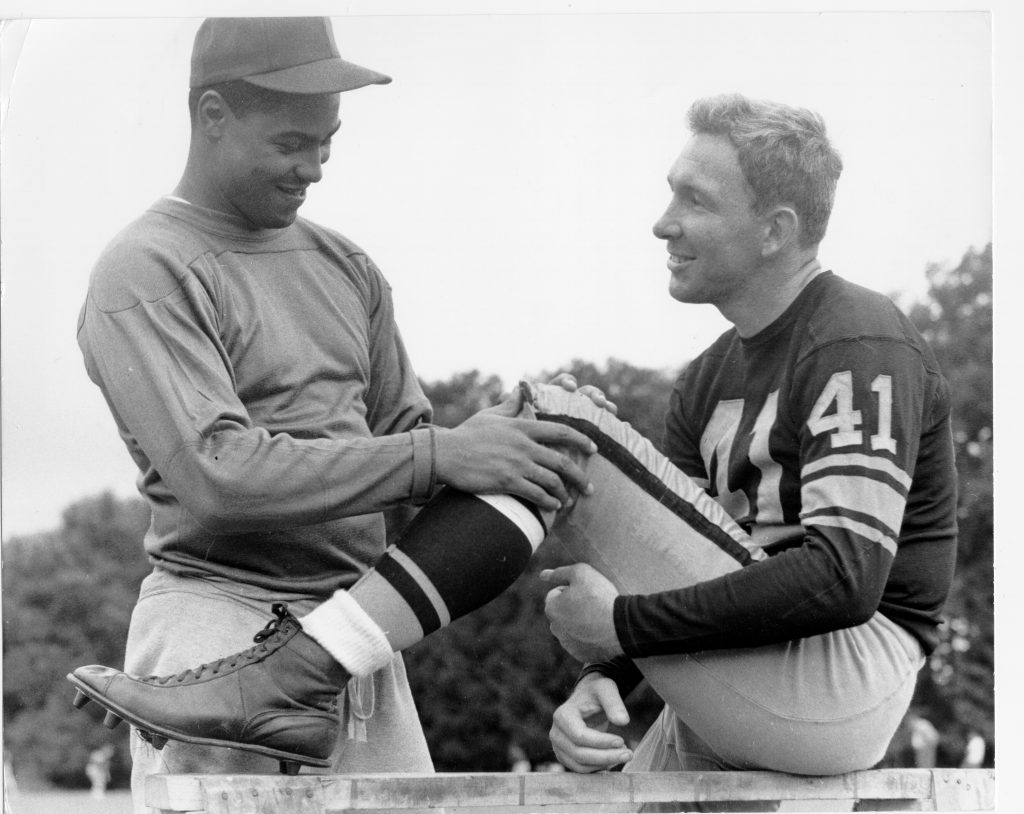
Johnny Lattner with Steelers trainer, c. 1955. Lattner gained 542 yards rushing and receiving in 1954, his only season with the Steelers. After serving in the Air Force he tried to make a comeback, but could not overcome the knee injury suffered while in the military. Courtesy of Pittsburgh Steelers.
In 1954, the Steelers chose Heisman Trophy Award winner Johnny Lattner with their first pick. An All-American and Maxwell Award winner, Lattner played only one year for the Steelers before joining the military, where a knee injury ended his football career. The most noted of the Fighting Irish alumni to make a name for themselves in Pittsburgh are four-time Super Bowl winner Rocky Bleier and Super Bowl XL champion Jerome Bettis.
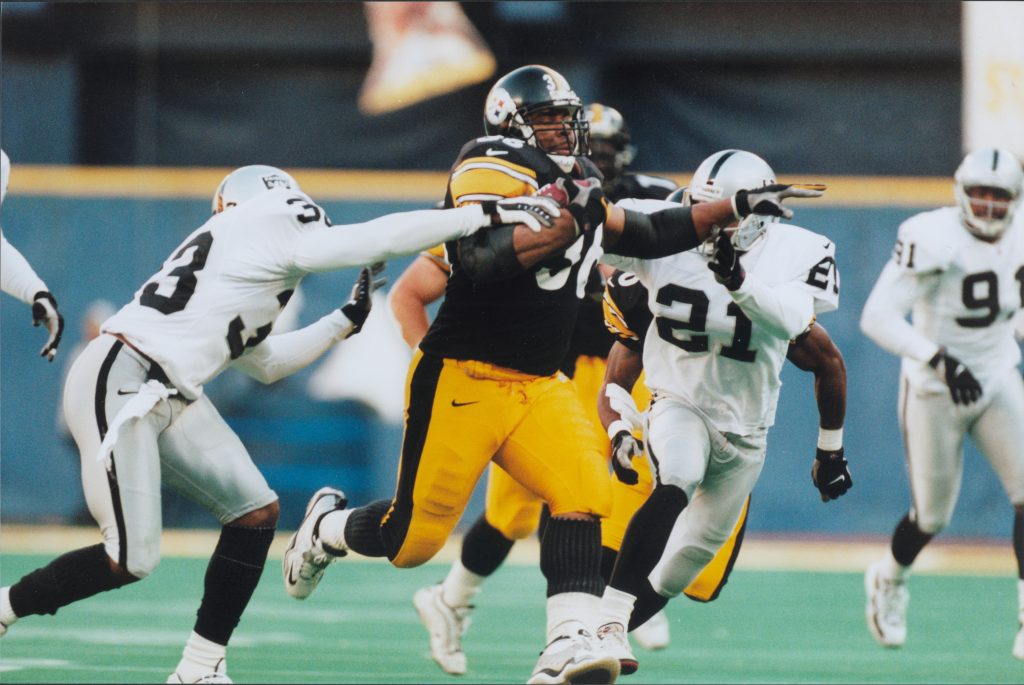
The Bus Powers Through, c. 2000. Jerome Bettis left Notre Dame after his junior year with 337 rushing attempts for 1,912 yards and 32 receptions for 429 yards. After three seasons with the Rams he came to the Steelers, where he rushed for more than 1,000 yards in each of his first six seasons. He capped his career in his hometown of Detroit, leading the Steelers to a victory in Super Bowl XL. Courtesy of Pittsburgh Steelers. Photo by Mike Fabus.
The pipeline has also run the other direction, carrying some of this region’s most promising high school talent west. Connellsville native John Lujack became the first Western Pennsylvanian to achieve at a top level while at Notre Dame. He quarterbacked the Irish in 1943, and then served three years in the navy during the war. After returning to South Bend, he led Notre Dame to a 17-0-1 record and national championships in 1946 and ’47. Lujack, who lettered in four sports, was named the Associated Press athlete of the year in 1947 and won the Heisman Memorial Trophy, the most prestigious award in college football. After turning pro, Lujack played for the Chicago Bears.
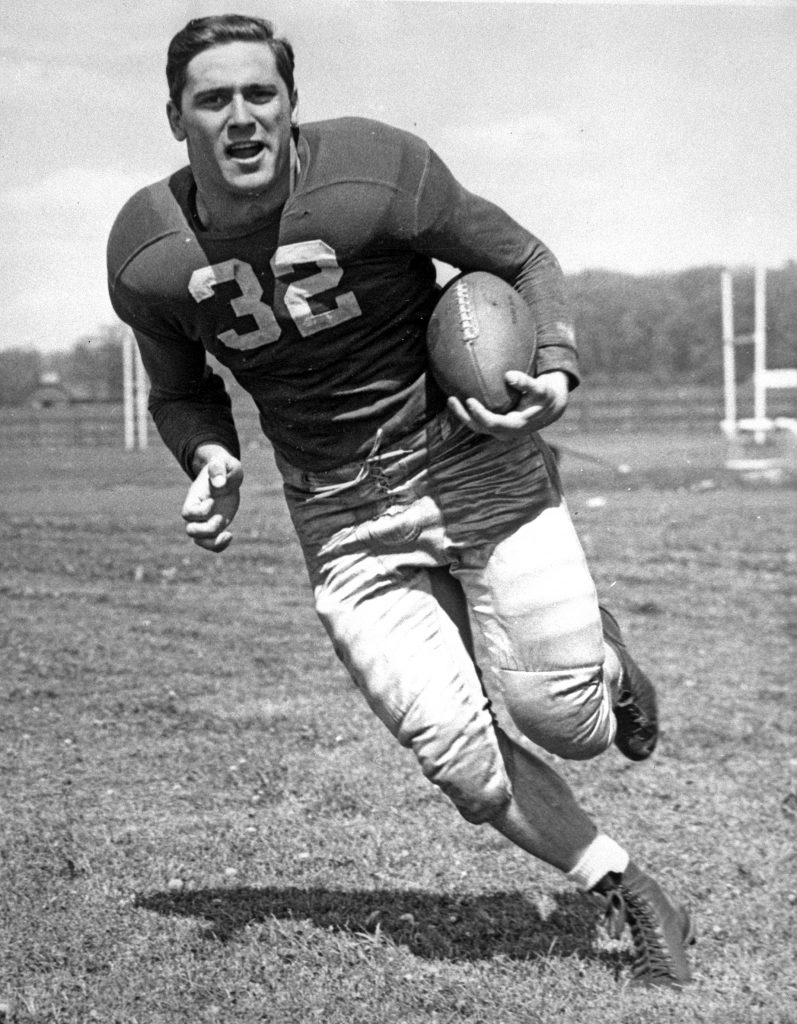
Johnny Lujack at Notre Dame, c. 1946. Courtesy of University of Notre Dame.
Lujack’s teammate, Leon Hart, crafted his own story of success. A native of Turtle Creek, Hart co-captained the national champion Notre Dame team in 1949. Only the second lineman to win the Heisman, he is considered by some to be the all-time All-American end. A runaway winner in Heisman voting, Hart was also a three-time All-American and the AP male athlete of the year in 1949. The first pick of the entire draft in 1950—one of only five Notre Dame players to achieve this—Hart went to Detroit. He played eight seasons for the Lions and won three world championships.
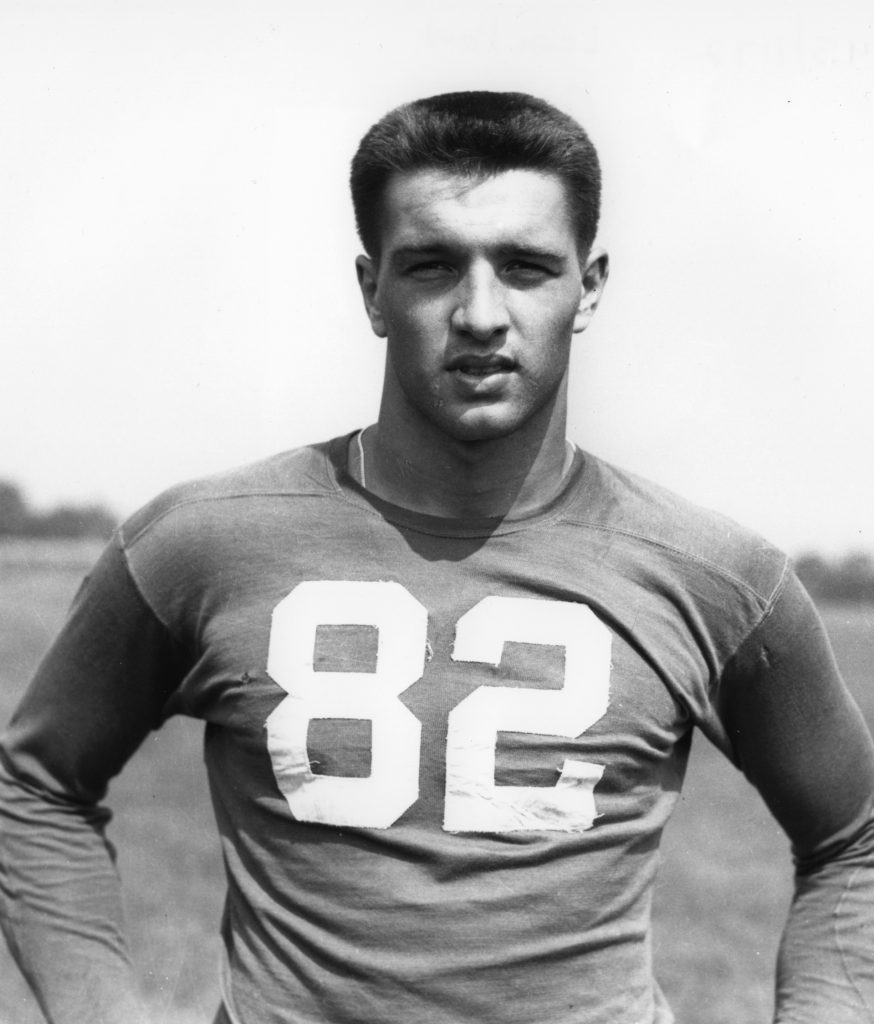
Leon Hart, courtesy of University of Notre Dame.
Three high schoolers, reared in this region’s cradle of quarterbacks, also made their mark in South Bend. Butler’s Terry Hanratty started from 1966 to 1968 and was named a consensus All-American in his final year. He finished third in the Heisman voting in 1968 (he was sixth in 1966 and ninth in 1967) and amassed a number of personal and career records. Drafted in the second round in 1969, Hanratty played for the Steelers from 1969 to 1975. Canevin High’s Tom Clements also guided the Fighting Irish and in his senior year was named an All-American and finished fourth in Heisman voting. He then spent 12 years in the CFL earning a number of awards, including the Rookie of the Year.
Hall of Famer Joe Montana is perhaps the best-known native to play for Notre Dame. Montana gave fans a taste of what to expect from him in the pros during the 1979 Cotton Bowl, when he returned to play after being sidelined with the flu and led the Irish back from a 22-point deficit to defeat Houston. After winning a national championship with Notre Dame, the “Comeback Kid” went on to win four Super Bowls and be named Super Bowl MVP three times with the San Francisco 49ers.
About the Author
Anne Madarasz is the director of the Franco Harris Sports Museum and chief historian at the Heinz History Center.
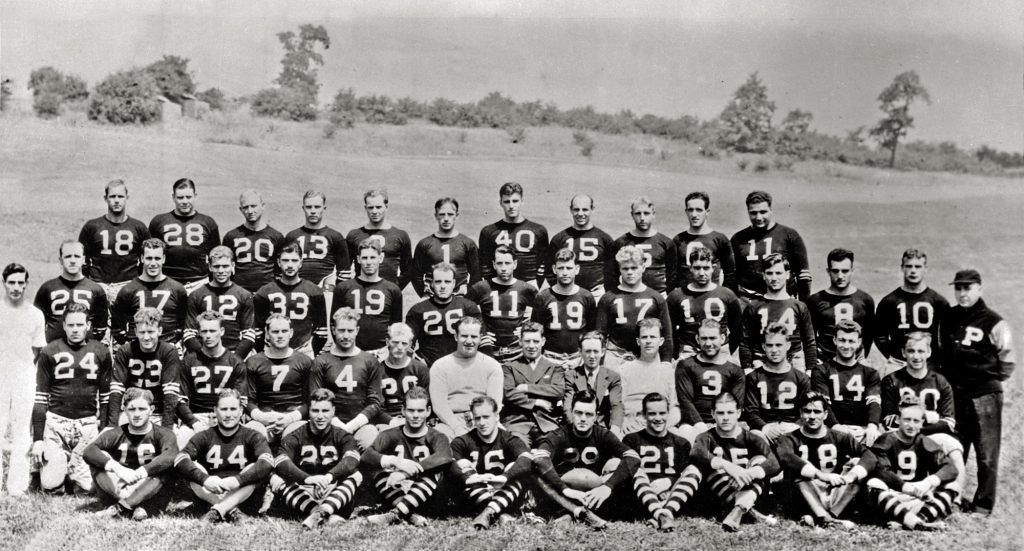
This team photograph features both Coach Joe Bach, a lineman on Notre Dame’s first national championship team who coached the Pirates in both 1935 and ’36 and then came back to the Steelers and coached in 1952 and ’53, and Norm Greeney, who spent two seasons with the team as an offensive lineman in 1934 and ’35. Bach is seated in the second row, eighth from the left, next to team founder Art Rooney, and Greeney is the player at the far right in that same row. Courtesy of Pittsburgh Steelers.