

It’s said that Pittsburghers bleed black and gold and, at least metaphorically, it seems true. We adorn our homes, our cars, and ourselves in all manner of the chosen colors. A dozen of us can’t get together without waving a black and gold towel—we bake in it, we buy it, it’s everywhere. But why?
The answer seems simple—we wear our city, and in a sense, our identity, on our sleeves. It all goes back to a fateful day in November 1758 when British Brigadier General John Forbes, who had assembled more than 5,000 men to march west and face the French army and their native allies, arrived at the Forks of the Ohio. There on Nov. 25, he found Fort Duquesne in ruins, burned to the ground by the French as they fled. Forbes claimed the spot now known as the Point for England and named it for the British Secretary of State, William Pitt the Elder. In a letter he penned to Pitt two days later he predicted, “These dreary deserts will soon be the richest and most fertile of any possessed by the British in North America.”
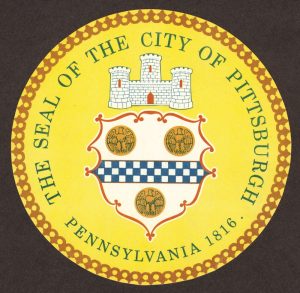
Seal of the City of Pittsburgh. Detre Library & Archives.
So how did we get from Forbes to a Steelers nation garbed in black and gold? In 1816, when Pittsburgh became officially chartered as a city, council commissioned silversmith George Harris to design a city seal. His design drew upon the colors and the symbolism of the Pitt family coat of arms. A theatrical performer and artist mentioned only as Mr. Jones may also have had some input on the design by adding a castellated wall to the crest.
Records of the seal’s creation were lost in the Great Fire of 1845, so when city leaders decided to create an official flag for Pittsburgh in 1898, they commissioned a committee to design it and report on the official colors of the city. That committee also used the colors found in the Pitt coat of arms: black, gold, silver or white, and blue. The flag has remained the same since 1899.
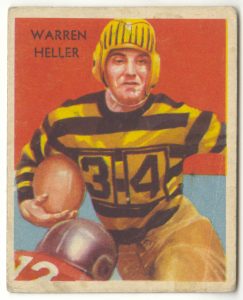
Pittsburgh Pirates football card, 1935.
Those colors were “pirated” by a series of teams, beginning in 1925. The National Hockey League’s Pittsburgh Pirates became the first major team known to wear them when they took to the ice at Duquesne Gardens in 1925 sporting bright yellow sweaters with a black “P” on the front. The hockey playing Pirates kept that color scheme until their fifth and final season when they switched to black and orange.
Art Rooney’s NFL Pirates-turned-Steelers have used a black and gold color scheme since their inception in 1933 and even briefly used the city seal in the team logo.

Pennant commemorating the Pirates winning the 1960 World Series.
In 1948, baseball’s Pirates set aside their traditional All-American white uniforms with red and/or blue accents and adopted black and gold as the key colors of the team. Adoption of the city standard is the common reason given for the change; it may also be tied to the relatively new ownership team who purchased the Pirates from the Dreyfuss/Benswanger family in 1946.
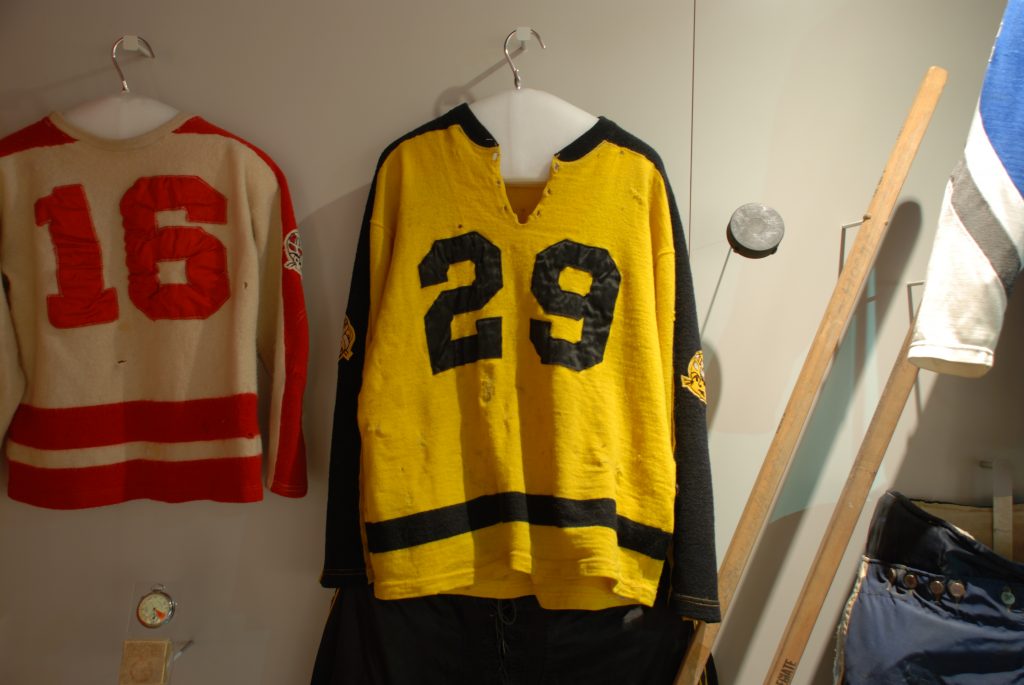
Willie Marshall’s black and gold Pittsburgh Hornets sweater. Gift of Glen Barton.
Black and gold could again be found on ice from 1951-53 when the AHL Pittsburgh Hornets made the switch from red and white jerseys. But it took a Super Bowl victory and a World Series win in the same “City of Champions” year to convince the Penguins to make the switch from blue and white to black and gold on Jan. 30, 1980. Since that time, the color choice has reigned supreme for all three of Pittsburgh’s major league teams and is now worn throughout the region by devoted fans.
About the Author
Anne Madarasz is the director of the Franco Harris Sports Museum and chief historian at the Heinz History Center.