
Professional football was born on the North Side in November 1892, fueled by an intense rivalry between the Pittsburgh Athletic Club and the Allegheny Athletic Association. Both believed themselves the best; both sought to assuage the sting of playing to a tie score on Columbus Day. And both were willing to use whatever means it took to win, including money.
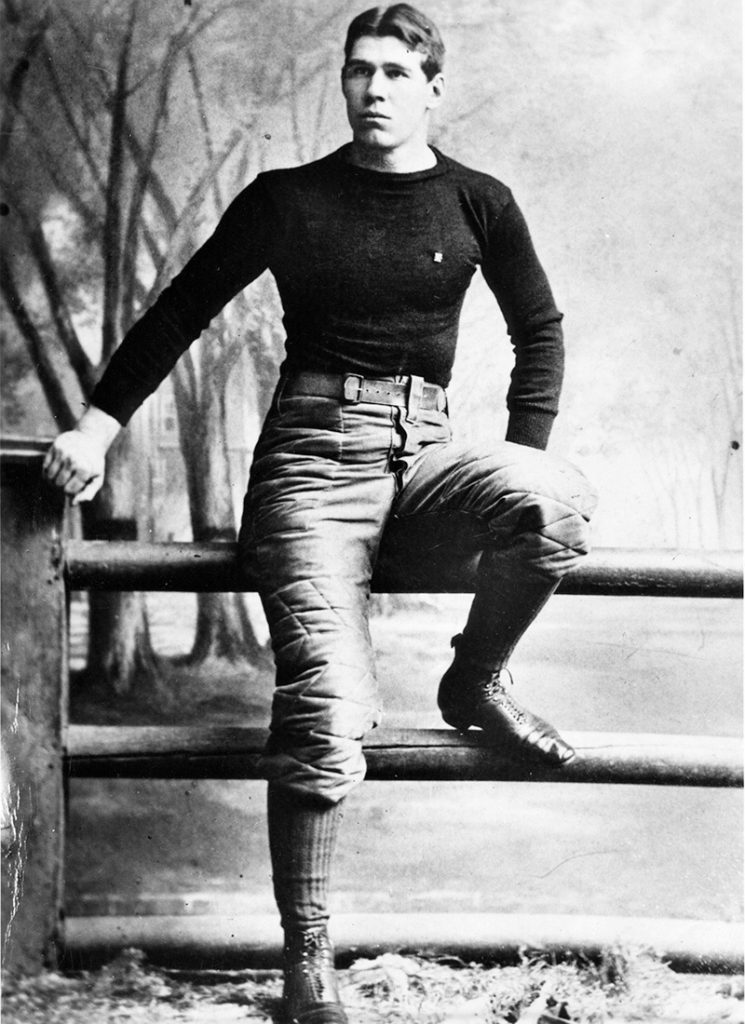
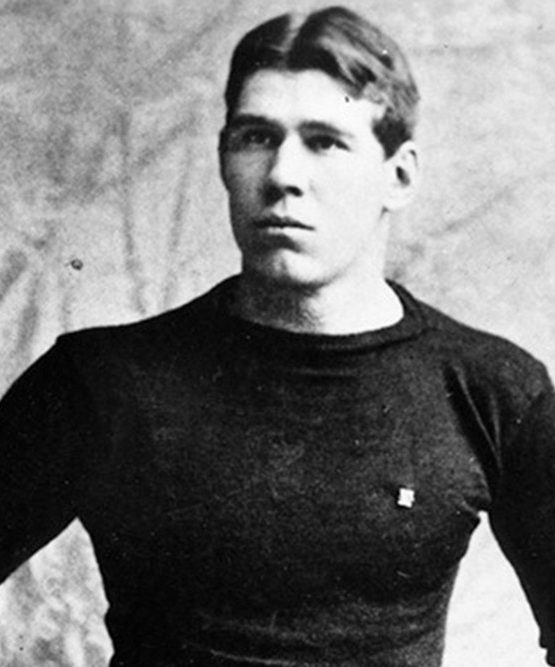
William “Pudge” Heffelfinger at Yale University, c. 1889. Considered the greatest lineman of his time, this college All-American played for independent clubs after graduating from Yale. Pro Football Hall of Fame.
The Allegheny Athletic Association (AAA) recruited former college football phenoms to play in the November 12 contest. Chief among them was William “Pudge” Heffelfinger, a former All-American guard at Yale brought in from Chicago for the game. Paid the sum of $500 to play, Heffelfinger delivered victory, scoring the only touchdown that day.
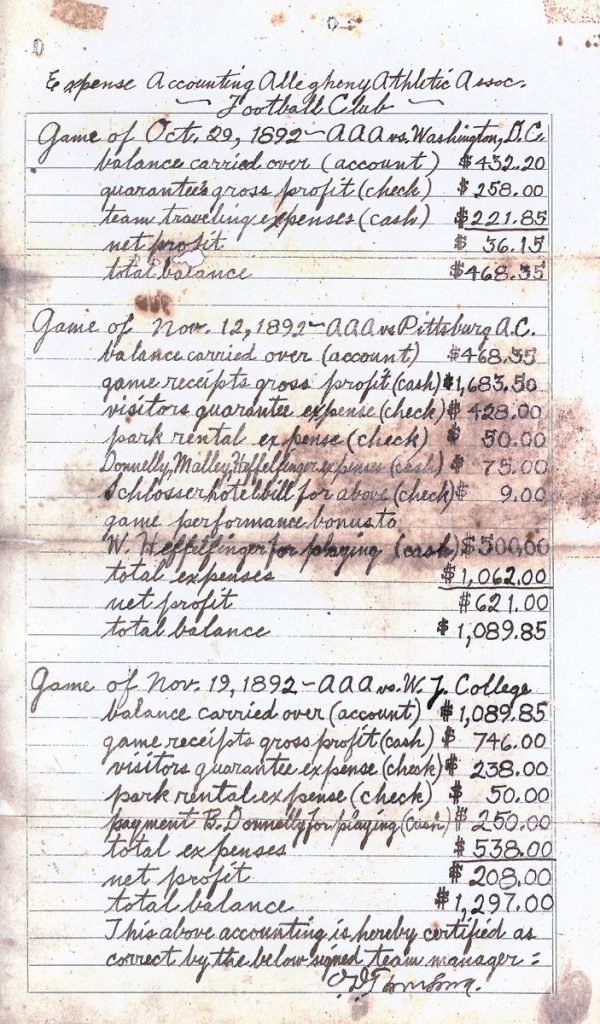
AAA ledger book showing payment of $500 cash to W. Heffelfinger, November 12, 1892. Pro Football Hall of Fame.
This local contest changed the game. Athletic clubs, the principal sponsors of early football, began to contract and pay players with the goal of athletic supremacy. In 1897, the Latrobe Athletic Association team played an entire season with only professionals. The roots of professional football, America’s premier spectator sport, were planted on the city’s North Side and blossomed throughout the region.
From those roots, a dynasty eventually emerged. When Pennsylvania’s Blue Laws (which prohibited pay for play on Sundays) made professional football fiscally untenable in this region, the formal organization of the professional league slid west to Ohio. Founded in Canton in 1920, the organization now known as the National Football League (NFL) took the lead in growing the game.
In 1933, believing that Pennsylvania would shortly revise its Blue Laws to allow pro sports on Sundays, Art Rooney bought an NFL franchise and named it the Pittsburgh Pirates, capitalizing on the reputation of the city’s baseball team. Needing to quickly fill a roster, Rooney enlisted former players from local colleges and some from the sandlot teams he had managed.
In the team’s first two seasons, played in the depths of the Depression, they lost not only games, but also money. Rooney’s challenges reflected the NFL’s — to make the league grow and prosper required competitive games that attracted a dependable fan base and built a workable business model.
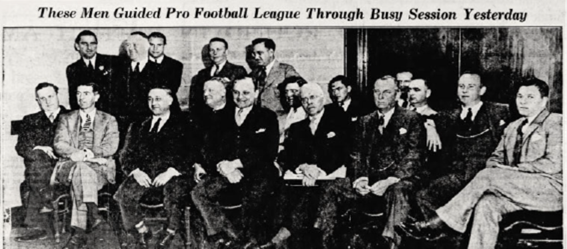
Mid-year meeting of NFL owners and coaches, Fort Pitt Hotel, Pittsburgh, May 19, 1935. Art Rooney hosted this 13-hour meeting at the Steelers offices that included passage of the proposal that outlined the main tenets of what we know as the NFL draft. The Pittsburgh Press, May 20, 1935.
A major first step at resolving these issues happened here in Pittsburgh at the midyear owner’s meeting in May 1935. Art Rooney hosted it at Steelers headquarters in the Fort Pitt Hotel. Rooney and Philadelphia Eagles owner Bert Bell argued that the established franchises held a competitive advantage over their teams. Flush with funds, they easily outbid the newly added teams in Pittsburgh and Philadelphia for players.
The ability to secure quality national players to better compete, build a fan base, and generate revenue became a key issue that Art Rooney championed. He argued for a system that limited the number of players the top teams could sign to “assure a more even race and prevent an eventual collapse of the league from sheer top-heaviness.”
At that meeting league owners adopted a proposal that stipulated that an annual draft occur where “the club which finished last in either division, to be determined by percentage rating, shall have first choice; the club, which finished next to last, second choice, and this inverse order shall be followed.”
This system, parts of which are still in use today, established parity and stabilized the league. The first official NFL draft, using the system formalized in Pittsburgh, was held in Philadelphia in 1936.
About the Author
Anne Madarasz is the director of the Franco Harris Sports Museum and chief historian at the Heinz History Center.