
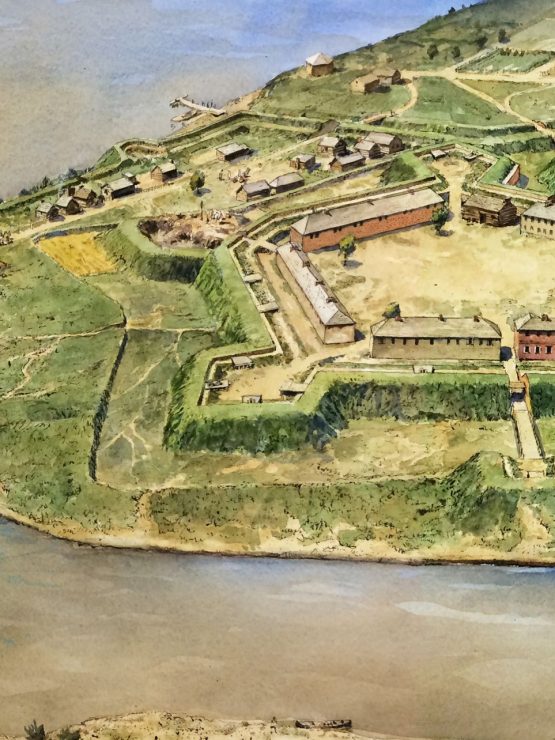
Pittsburgh’s Revolution
OPEN NOW
It happened right here.
As the nation approaches its 250th anniversary, the Fort Pitt Museum unveils Pittsburgh’s Revolution, a dynamic new exhibition exploring Western Pennsylvania’s pivotal role in the Revolutionary War and its impact on the founding of America.
Located at the headwaters of the Ohio River, Fort Pitt was the epicenter of the Revolutionary War in the West. From this frontier stronghold, American leaders defended the Ohio Country, negotiated with Native nations — including the Delaware, Shawnee, and Six Nations, or Iroquois, Confederacy — and ultimately waged a war that reshaped the region forever. Violent, chaotic, and unfamiliar to many today, this corner of the Revolution was critical to American victory and the future of the new nation.
Through striking imagery, compelling artifacts, and dynamic interpretation, Pittsburgh’s Revolution brings the Western theater of the fight for independence to life through the eyes and words of those who lived it.
Explore the stories of a dynamic and diverse cast of characters, including George Washington, Simon Girty, Guyasuta, Caesar, Nonhelema, George Morgan, White Eyes, and more.
The exhibition features one of the rarest existing objects from the American Revolution: the original Westmoreland Battalion Flag, created for Col. John Proctor’s 1st Battalion of Westmoreland County in 1775. The flag, bearing the iconic rattlesnake and defiant revolutionary era motto “DONT. TREAD. ON. ME.,” predates the Stars and Stripes and stands as a powerful symbol of frontier resistance and the revolutionary spirit in Western Pa.
Exhibition highlights:
- A 1777 letter written by Founding Father Patrick Henry emphasizing the importance of defending Fort Pitt “to the last extremity.”
- A rare Spanish musket, restocked in Pennsylvania and used in the Revolution.
- The trunk and tea cannister used by Continental Army paymaster John Boreman to secretly transport the money used to pay American troops at Fort Pitt.
- Archaeological discoveries from Hanna’s Town, Westmoreland County, which was destroyed by a Native and British force near the war’s end in 1782.
- The sword and pistols of General William Irvine, who commanded Fort Pitt from 1781 to 1783.
Throughout the exhibition run, experience living history on the Fort Pitt Museum lawn, featuring 18th-century demonstrations and cannon and artillery firings across Point State Park.
Presented in recognition of America’s 250th anniversary, Pittsburgh’s Revolution invites visitors to explore the people, conflicts, and consequences that unfolded at the Forks of the Ohio, and to consider how the events that happened here continue to shape our region and nation today.
This exhibition is part of the Heinz History Center’s year-long commemoration of the U.S. Semiquincentennial, marking the 250th anniversary of the signing of the Declaration of Independence, in partnership with America250PA.
America250PA was established by the Pennsylvania state legislature and Governor in 2018 to plan, encourage, develop and coordinate the commemoration of the 250th anniversary of the founding of the United States, Pennsylvania’s integral role in that event, and the impact of its people on the nation’s past, present, and future.
Heinz History Center programs commemorating America’s 250th anniversary are supported by Nimick Forbesway Foundation, Richard King Mellon Foundation, Visit PA, and the Allegheny Regional Asset District (RAD).